Are you sourcing ceramic mugs for your brand, but worried about receiving a batch where every piece is slightly different? This inconsistency can quickly agitate your customers, leading to negative reviews, costly returns, and damage to your hard-won brand reputation. The solution lies in understanding how automated mug production directly translates to the batch-to-batch predictability your business needs to thrive.
Automated mug production improves consistency by using precision machinery to control every critical step of the manufacturing process, from forming the clay to applying the glaze and decals. This minimizes the human error inherent in manual methods, resulting in mugs that are uniform in size, weight, shape, color, and logo placement, thereby reducing defect rates and ensuring every unit meets brand specifications.
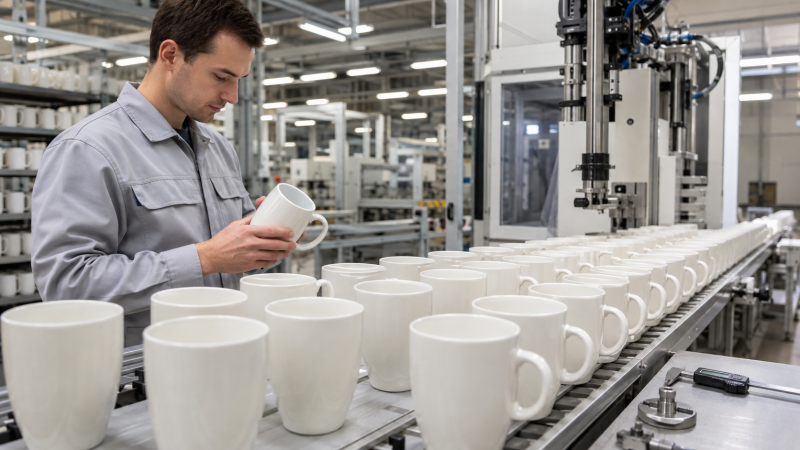
This level of control is not just about making a "perfect" mug; it's about delivering a predictable product that protects your investment and delights your customers. Let's dive deeper into how specific automated processes solve real-world business problems for wholesalers and e-commerce sellers.
How Does Automated Forming Reduce Your Total Cost of Ownership?
Have you ever faced the logistical nightmare of a mug shipment that doesn't fit your pre-ordered packaging? This simple size variation can halt your operations, inflate shipping costs, and create expensive waste. The key to preventing this is investing in a supplier who leverages automated forming technology.
Automated forming uses precisely calibrated molds and hydraulic or isostatic presses to shape each mug. This ensures every single unit has identical dimensions—height, diameter, and handle placement—within sub-millimeter tolerances, guaranteeing a perfect fit for your packaging and a lower total cost of ownership.
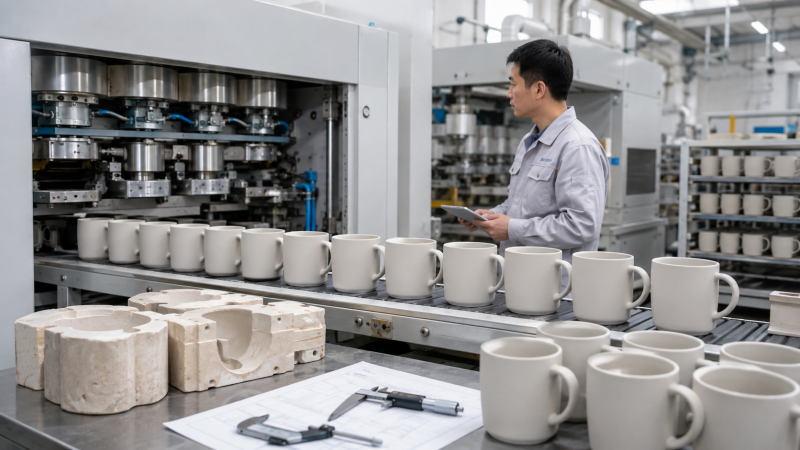
Dive Deeper: The Packaging Nightmare and Hidden Costs
Over my 15 years in this business, I've seen how a seemingly small detail like mug dimensions can have a massive financial impact. We once had a new e-commerce client who learned this the hard way. They sourced manually-produced mugs from another supplier to save a few cents per unit. The first shipment arrived, and their team discovered that about 30% of the mugs were slightly too wide or too tall for the custom-branded boxes they had spent thousands on.
This created a cascade of problems:
- Increased Labor Costs: Their staff had to manually sort through thousands of mugs, trying to find ones that fit.
- Wasted Packaging: Hundreds of expensive boxes had to be discarded.
- Shipping Delays: The fulfillment of customer orders was delayed by over a week, leading to complaints.
- Higher Shipping Fees: To protect the ill-fitting mugs, they had to use extra dunnage, which increased the dimensional weight and cost of each parcel. The details of shipping ceramic mugs from China to USA / landed cost can be complex, and unexpected packaging changes only make it worse.
When they switched to our automated mug production line, the problem vanished. Our mugs, produced with automated forming, fit their packaging perfectly, every time. This transformed their packaging from a variable, high-risk cost into a predictable, fixed expense. This is a core part of the complete ceramic mug production process we've refined.
The consistency from automated forming provides benefits beyond just packaging:
| Feature | Manual Forming Risk | Automated Forming Benefit | Business Impact |
|---|---|---|---|
| Dimensions | High variation in height/diameter | Sub-millimeter consistency | Predictable packaging and shipping costs. |
| Weight | Inconsistent material usage | Uniform weight per unit | Accurate shipping weight calculations. |
| Stackability | Unstable stacking in warehouse | Secure, stable stacking | Optimized warehouse space and safety. |
For a wholesaler or e-commerce brand, choosing automated forming isn't a technical preference; it's a strategic decision to control downstream costs and operational efficiency. It's about ensuring your product integrates seamlessly into your logistics chain, from the factory floor to the customer's doorstep.
Can Automated Mug Production Protect Your Brand's Reputation?
Is there anything more damaging to a brand than an off-center or crooked logo on your product? This small defect screams "cheap" and "unprofessional," instantly eroding the trust you've built with your customers. For any business selling custom ceramic mugs, protecting brand integrity on every single unit is non-negotiable.
Yes, automated mug production is one of the most effective ways to protect your brand's reputation. By using automated decal application systems, it ensures your logo or design is placed in the exact same position, with the same orientation, on every mug, creating a professional and consistent brand experience.
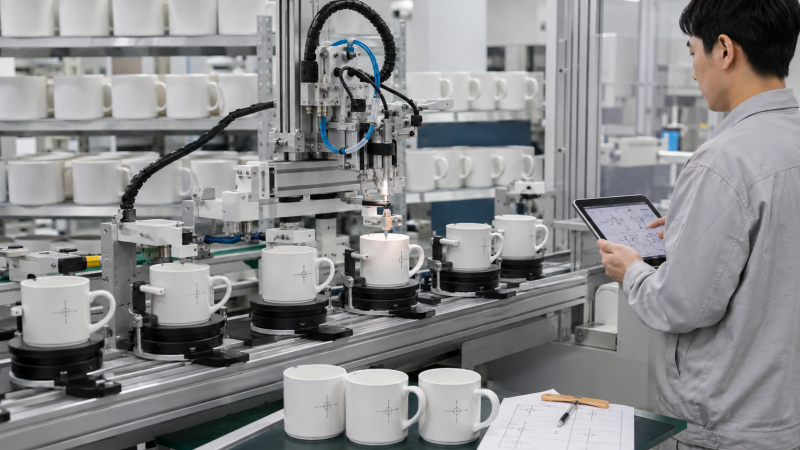
Dive Deeper: Brand Integrity Is in the Details
The first thing our most successful e-commerce clients ask about is not the price, but our process for ensuring their logo looks perfect on every mug. They understand that their brand is their most valuable asset.
Manual decal application, while suitable for artisanal one-offs, is fraught with risk for commercial-scale production:
- Positional Drift: A worker may place the decal a few millimeters higher or lower throughout the day due to fatigue.
- Tilting: Logos can be slightly crooked, which is immediately noticeable to the end consumer.
- Bubbles and Wrinkles: Rushed application can trap air or create wrinkles under the decal, which become permanent flaws after firing.
These inconsistencies mean that within the same shipping carton, a customer could find mugs with visibly different logo placements. This is a disaster for any brand that values a premium image.
Automated mug production solves this with robotic precision. Our automated decal machines use sensors and fixed jigs to hold the mug in the exact same orientation every time. A robotic arm then applies the decal with consistent pressure and positioning.
This part of the ceramic mug production process is crucial for brand-focused clients. It moves the conversation from "Can you put my logo on a mug?" to "Can you replicate my brand's visual standard 100,000 times without deviation?" As a reliable mug manufacturer in China, our answer is a confident "yes," because our process is system-driven, not dependent on human variability. This commitment to precision is a fundamental part of our ceramic mug quality control philosophy.
When you're building a brand, you're making a promise of quality to your customer. Automated decal application ensures the product you ship always keeps that promise.
How Does an Automated Glazing Process Lower Customer Complaints?
Are you tired of seeing customer reviews that complain about pinholes, drips, or rough spots on your mugs? These surface blemishes are often the first thing a customer notices, leading to returns and the perception of poor quality. An automated glazing process is your best defense against these costly complaints.
Automated glazing, typically using a spray system on a conveyor, applies a perfectly even coating of glaze to every surface of the mug. This eliminates common manual dipping defects like drips, runs, and uneven thickness, resulting in a smooth, durable, and visually appealing finish that drastically reduces customer complaints.
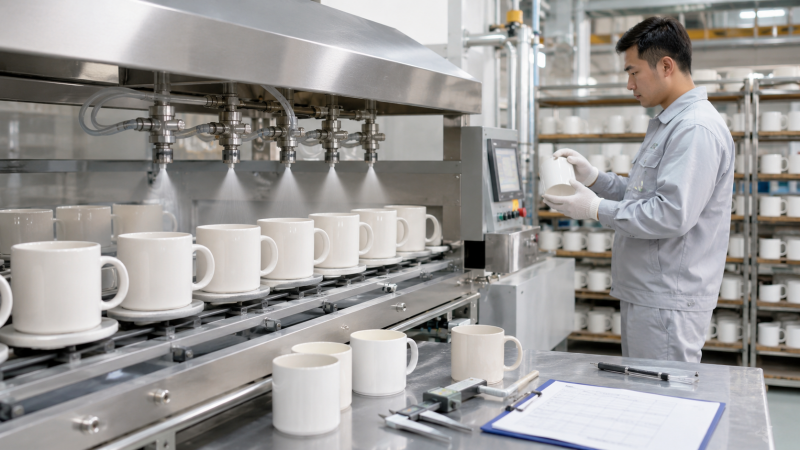
Dive Deeper: From Surface Flaw to Business Problem
A tiny pinhole in the glaze isn't just a cosmetic issue; it's a potential business liability. These small defects are often what separate a 5-star review from a 2-star review. When you visit a facility like our automated ceramic mug factory, you see how automation directly targets these issues.
Here are the common defects found in manual glazing and how automation solves them:
-
Drips and Runs: In manual dipping, excess glaze can run down the side of the mug, creating an unsightly raised line after firing.
- Automation Solution: Automated spray systems apply a fine, controlled mist, preventing any accumulation of excess glaze. The coating is uniform from top to bottom.
-
Finger Marks: Where the worker holds the mug during dipping, the glaze can be thin or smudged.
- Automation Solution: Mugs are held by mechanical grips on the bottom or inside, areas that don't detract from the user experience, ensuring the main body is consistent surface finish.
-
Uneven Thickness: A slightly longer or shorter dip time can result in a glaze that's too thick (and prone to cracking) or too thin (showing the ceramic body underneath).
- Automation Solution: The conveyor speed and spray nozzle output are precisely calibrated and computer-controlled. Every mug receives the exact same amount of glaze for the exact same duration.
-
Pinholes: These tiny holes are often caused by air bubbles trapped during a rushed manual dip.
- Automation Solution: The consistent, fine spray application minimizes the introduction of air, leading to a much lower incidence of pinholes.
Ultimately, a smooth, consistent glaze does more than just look good. It improves the mug's durability, makes it more pleasant to hold, and presents a clean canvas for your branding. By choosing a supplier that uses automated mug production with advanced glazing techniques, you are proactively managing your quality and reducing the rate of returns and negative reviews that eat into your profit margins. It's a clear example of how a better production process leads to a better business outcome.
Frequently Asked Questions
What is the difference between handmade and machine-made mugs for a business?
For a business, the key difference is predictability versus uniqueness. Handmade mugs are like art; each piece has variations that make it unique. Machine-made mugs from an automated mug production line are commercial products designed for replicability. They ensure every unit is consistent, which is essential for branding, packaging, and scalable sales.
Does automation mean the mug has less "character"?
This is a common misconception. "Character" in a commercial product should come from your brand's unique design, not from random production flaws. Automation ensures that your intended design is executed perfectly and consistently across thousands of units. The character is your brand, and automation protects it.
Is automated production more expensive?
While the per-unit cost might be slightly higher than the cheapest manual options, the Total Cost of Ownership (TCO) is almost always lower. Automated mug production saves you money by eliminating the hidden costs of returns, brand damage, wasted packaging, and negative reviews that come from inconsistent quality.
How does automation affect the ceramic mug production process timeline?
Automation generally leads to faster and more predictable production timelines. Manual processes are more susceptible to human factors, leading to variable output and quality control bottlenecks. An automated ceramic mug factory can provide more reliable lead times and has the capacity to scale up production to meet growing demand without sacrificing quality.
Conclusion
Choosing the right manufacturing process for your ceramic mugs is a critical business decision, not just a technical one. As we've seen, automated mug production is the most reliable strategy for ensuring the consistency your brand needs to succeed. It delivers uniformity in size, which solves logistical nightmares and reduces packaging costs. It guarantees precise branding, protecting your reputation with every unit sold. Finally, it creates a consistent surface finish surface finish, minimizing customer complaints and costly returns. For any serious wholesaler or e-commerce seller, the benefits go far beyond the product itself—they directly impact your operational efficiency, brand equity, and bottom line.
If you are looking for a predictable, scalable, and high-quality supply of custom ceramic mugs, our automated processes are designed to be the solution. Contact us today to discuss how our factory's capabilities can help you lower your total cost of ownership and grow your brand with confidence.