Are you worried that the perfect mug sample you approved won't be what you receive in your bulk shipment? It's a common fear for importers. This inconsistency can lead to negative customer reviews, costly returns, and damage to your brand's reputation. Understanding the ceramic mug manufacturing process is the key to mitigating this risk, and it starts in a place most people overlook.
A finished mug is created through a multi-stage process that includes preparing a precise clay mixture, forming the mug body and handle, a preliminary (bisque) firing, applying glaze, and a final (glost) firing to vitrify the product. Crucially, the entire journey is underpinned by rigorous quality control, especially during the initial raw material preparation, which is the most critical step for ensuring consistency from the first sample to the final unit in a mass production run.
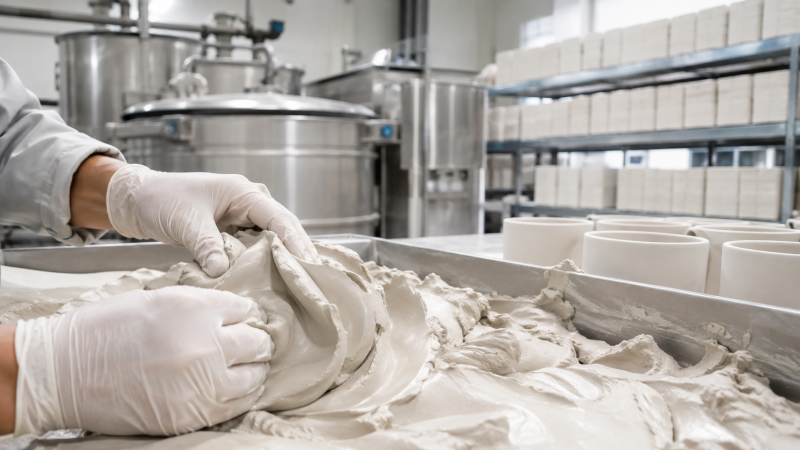
Now that you have the bird's-eye view, let's walk the factory floor together. I want to show you the specific steps we take, not just to make a mug, but to manufacture consistency. The journey to a perfect finished mug starts long before a potter's wheel or a kiln.
Why is Raw Material Preparation the Most Critical Step in the Ceramic Mug Manufacturing Process?
You've approved a beautiful, flawless sample. The color is perfect, the finish is smooth. A question I often get at this point is, "How can I be sure the 10,000 I order will be just like this one?" The anxiety is understandable.
The answer lies in the very first stage: raw material preparation. Inconsistent clay is the number one cause of variations in color, strength, and defect rates between batches. True quality control doesn't start at final inspection; it starts with the dirt.
The Foundation of Quality: The Clay Recipe
A ceramic mug isn't made from just any clay dug from the ground. It's an engineered material. Our base formula is a precise blend of different components, primarily:
- Clay (Kaolin): Provides plasticity, which is the ability to be shaped without cracking.
- Feldspar: Acts as a flux, melting at a lower temperature to bind all the materials together and form glass, making the mug non-porous.
- Quartz (Silica): Provides structural integrity to the mug body during and after firing.
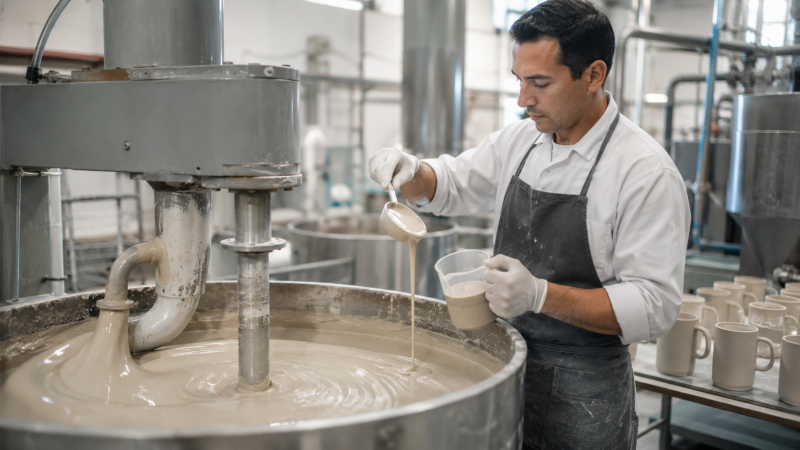
Each batch of these raw materials is tested for its properties before being accepted into our warehouse. We then weigh them according to a specific, documented recipe and mix them in large vats with water to create a liquid slurry. This mixing process runs for a minimum of two hours to ensure complete homogenization. A poorly mixed batch is a primary source of inconsistency.
The Invisible Enemy: Iron Contamination
Here's something that separates a good supplier from a great one. After creating the slurry, we pass it through a multi-stage iron removal process. This involves pumping the liquid clay through powerful electromagnets and fine mesh screens.
Why is this so important for your business? Iron is a naturally occurring mineral in clay. Even tiny particles, invisible in the liquid slurry, can cause big problems. During firing, these iron particles will burn and create small, dark brown or black specks on the finished mug. For an e-commerce seller, these are the source of reviews that say, "My mug arrived with weird black dots on it." For a wholesaler, it means a higher defect rate and unhappy retail partners. By investing heavily in this iron removal step, we're directly investing in protecting your brand's image. This is a key part of how we manage and reduce common defects in ceramic mugs.
Here’s how our processed clay compares to a standard, less-controlled process:
| Feature | Standard Clay Processing | Our Multi-Stage Process | Business Benefit for You |
|---|---|---|---|
| Iron Content | Variable | < 0.1%, consistently low | Drastically fewer black spots/pinholes |
| Particle Size | Inconsistent | Homogenized & filtered | Smoother surface finish, fewer imperfections |
| Color Base | Can be off-white/grey | Consistent bright white | True-to-sample color and better for printing |
| Batch Consistency | Low | High | Bulk order matches the approved sample |
This meticulous attention at the very beginning is the bedrock of the entire ceramic mug manufacturing process.
How Do We Ensure Every Mug Has the Same Shape and Handle?
A slight wobble, a crooked handle, or a difference in capacity can make a product feel cheap. When a customer buys a set of mugs, they expect them to be uniform. So, how do we guarantee this across thousands of units?
The answer is a combination of high-precision molds and a well-defined process that blends automation with skilled manual work. Every step is designed to replicate the approved shape with minimal deviation.
Forming the Body and Handle
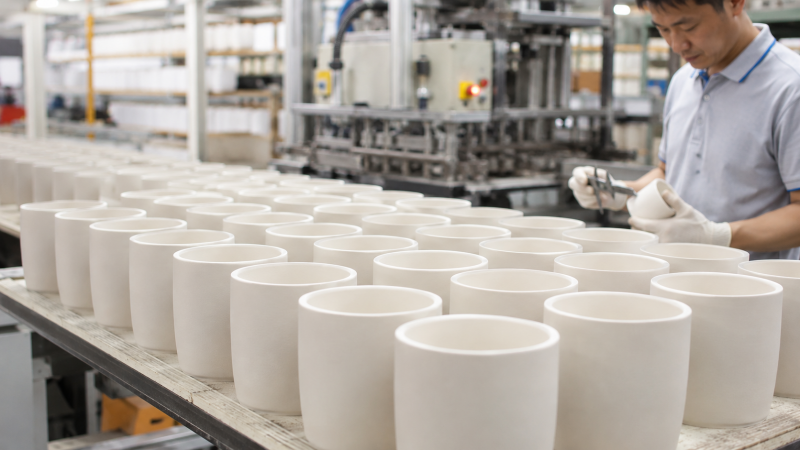
There are a few ways to form a mug. For most of our standard round mugs, we use an automated process called jiggering. A lump of processed clay (called pug) is dropped into a spinning plaster mold, and a shaping tool descends to press the clay against the mold wall, forming the interior shape. This ensures the exterior shape and wall thickness are identical every time.
Handles are typically made separately using slip casting. The liquid clay slurry is poured into a handle-shaped mold. The plaster mold absorbs water from the slurry, forming a solid layer on the inside. The excess slurry is poured out, leaving a perfectly formed handle. This is a key area where our investment in automated mug production helps maintain consistency.
The real skill comes in attaching the handle. This is often done by hand. Our workers use a technique called "slip and score." They scratch the surfaces of the mug and the handle where they will join and apply a bit of liquid slip (clay glue). This creates a strong, seamless bond. A question I often get from clients during a factory tour is about handle strength. We perform regular stress tests on a sample basis, pulling on the handles with a calibrated machine to ensure they exceed durability standards.
The Critical Drying Phase
After forming, the "greenware" mugs are very fragile and contain a lot of water. They must be dried slowly and evenly before they can be fired. Rushing this step is a recipe for disaster, leading to cracks and warping. We place the mugs on racks in a drying room with controlled temperature and humidity. This controlled environment ensures that the mugs dry from the inside out at a uniform rate, which is critical for maintaining their shape and structural integrity before the first firing.
What Makes the Firing Stage Key to the Ceramic Mug Manufacturing Process?
The kiln is where the magic and the science truly intersect. A soft, fragile piece of clay enters, and a hard, durable ceramic mug emerges. However, this transformation is a volatile process. Without precise control, the kiln can just as easily create a batch of cracked, discolored, or warped rejects.
The firing process is essential for achieving the required hardness, correct glaze color, and a flawless, food-safe surface. It's a two-part journey: a low-temperature bisque firing followed by a high-temperature glaze firing.
The First Firing: Bisque
After the mugs are fully dried, they go into the kiln for the first time. This is called a "bisque" or "biscuit" firing. We slowly heat the mugs to around 900-1000°C (1650-1830°F).
The purpose of this firing is not to create the final product, but to prepare it for glazing. The bisque firing burns out organic matter, removes chemically bonded water from the clay particles, and turns the fragile greenware into a hard but porous ceramic state. This porosity is crucial—it allows the mug to absorb the liquid glaze evenly, like a sponge.
Glazing and the Final Firing
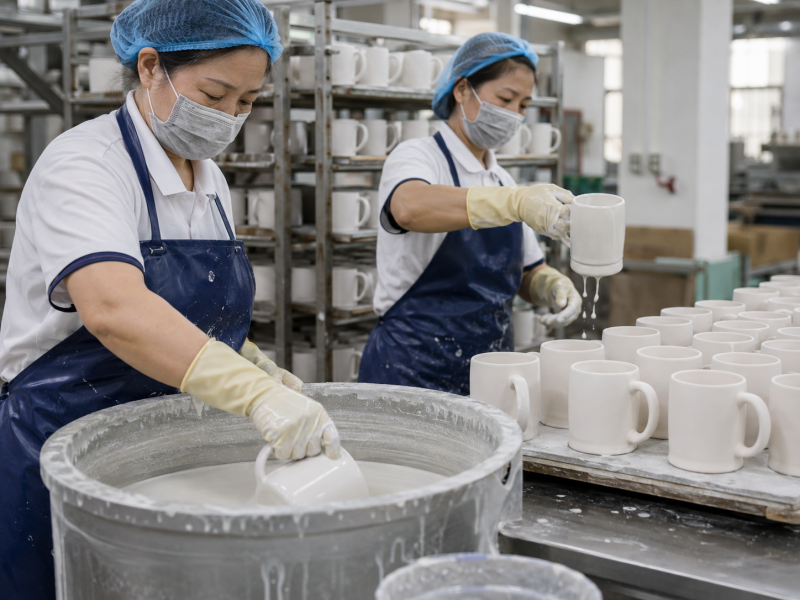
Once cooled, the bisque-fired mugs are ready for glazing. The glaze is essentially a form of liquid glass. When fired, it will melt and fuse to the ceramic body, creating the smooth, non-porous, and colorful surface of the finished mug. We apply the glaze either by dipping the mugs into a large vat or by spraying it on for more complex designs. Glaze thickness is constantly measured; too thin and the color is weak, too thick and it can run or crawl during firing.
The glazed mugs then head to the second and final firing, often called the "glost" firing. This time, the temperature is much higher, typically between 1250°C and 1300°C (2280-2370°F). During this firing:
- The glaze melts, flows over the surface, and becomes glass.
- The clay body continues to shrink and vitrify, meaning its particles fuse together, making it incredibly strong and non-porous.
We use modern tunnel kilns, where the mugs travel on a conveyor through different temperature zones. This allows for a very precise heating and cooling curve, which is programmed based on the specific clay and glaze being used. This level of control is fundamental to our ceramic mug quality control system and ensures that colors are consistent and defects like cracking are minimized.
How Do We Perform a Final Mug Factory Inspection?
A finished mug might look great from a few feet away, but we know that your brand's reputation—and your customers' satisfaction—depends on the fine details. The final inspection is not just a quick glance; it's a systematic process.
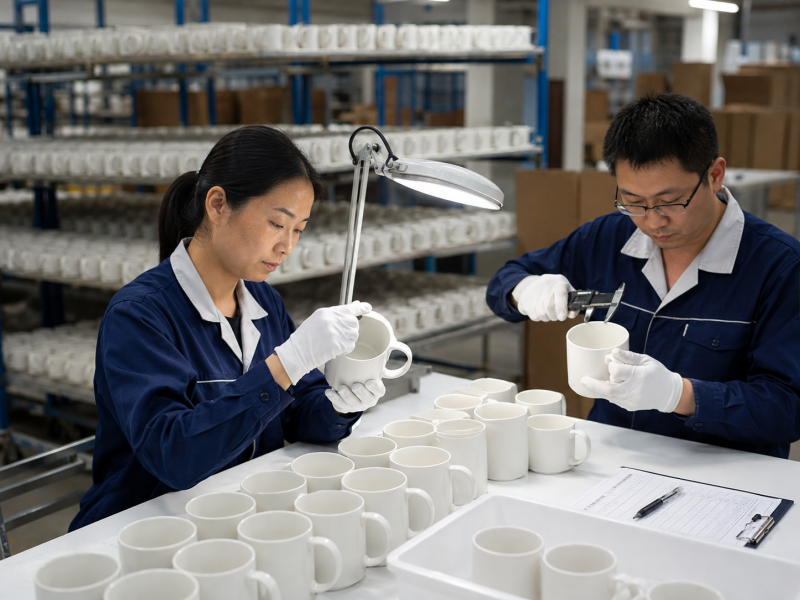
Our final mug factory inspection is a comprehensive, multi-point check where trained inspectors evaluate every single mug against the approved sample and the quality standards defined with the client, such as the Acceptable Quality Limit (AQL).
Decoration and Final Firing
If the mug includes a logo or design, this is typically applied after the glost firing using ceramic decals. These are printed with special ceramic inks onto a carrier paper. The decals are carefully applied by hand to the glazed mug. The mug then goes through a third, lower-temperature firing to permanently fuse the decal's design into the glaze itself. This makes the design extremely durable and dishwasher-safe.
The Inspector's Checklist
After the final firing and cooling, every single mug is sent to the inspection and packing department. Here, under bright lighting, our inspectors check each piece. They work from a detailed checklist that includes:
- Visual Inspection: Looking for any surface flaws like cracks, chips, pinholes (from iron), glaze crawling, blisters, or color inconsistencies. They compare the mug's color to the approved Pantone swatch under a controlled light source.
- Dimensional & Capacity Check: Using calipers, they measure the height and diameter of a sample of mugs from the batch to ensure they are within the agreed-upon tolerance (e.g., +/- 2mm). They also check the liquid capacity.
- Handle & Body Integrity: Tapping the mug gently to listen for the clear ring that indicates no hidden cracks. They also physically check the handle attachment point.
- Decal Quality: Inspecting the logo or design for correct placement, color accuracy, and any scratches or misprints. They perform an adhesion test to ensure the decal is properly fused.
Any mug that does not meet the standard is rejected. This rigorous final check is the last line of defense in the ceramic mug manufacturing process and is a critical part of any serious ceramic mug supplier evaluation. It's our final promise to you that what we pack is what you ordered.
Frequently Asked Questions
How long does the entire ceramic mug manufacturing process take?
From raw clay preparation to a packed, finished mug, the process typically takes about 7 to 10 days. This does not include initial mold creation, which can take a few weeks. The long drying and firing cycles are the main reason it can't be rushed.
What's the difference between ceramic and porcelain mugs?
The main differences are the raw materials and firing temperature. Porcelain is made from a more refined, purer clay (kaolin) and is fired at a higher temperature (often above 1300°C). This makes it harder, denser, less porous, and typically whiter and more translucent than standard ceramic.
Are your mugs food-safe and lead/cadmium free?
Absolutely. The glazes we use are formulated to be completely lead and cadmium-free. We adhere to international food safety standards, including FDA, EU regulations, and California's Prop 65. For every order, we can provide third-party testing reports from labs like SGS or Intertek to verify compliance.
How do you ensure the color of my logo is accurate?
We use the Pantone Matching System (PMS) for color accuracy. You provide us with the Pantone code for your brand colors, and we create custom ceramic inks to match it. Before mass production, we will produce a physical, fired sample with your logo for your approval to guarantee the color is exactly what you expect.
Conclusion
As we've seen on this factory tour, creating a consistent, high-quality finished mug is not an accident. It is the result of a disciplined and detailed ceramic mug manufacturing process that prioritizes quality at every single step. While the final inspection is important, the real secret to mitigating your risk as an importer lies at the very beginning: in the meticulous preparation of raw materials. This foundational work ensures that the thousandth mug is as flawless as the first sample you approved. It's how we transform clay and glaze into a reliable product for your business.
If you're looking for a manufacturing partner who understands that consistency is as important as creativity, I invite you to discuss your next project with us. Contact our team to learn more about our quality control systems and begin your supplier evaluation.