Trying to figure out how large supermarkets get their drinkware products so affordably can feel like a frustrating puzzle. You see the low prices on the shelf and assume that with a bit of searching, you can find a factory in China to give you the same deal. The problem is, every attempt to go "direct" seems to lead to communication breakdowns, surprise costs, or quality issues that wipe out any potential savings. The secret isn't just about finding a cheaper factory; it's about understanding the real process of supermarket drinkware sourcing, a professional system built on managing total cost and risk, not just the unit price on an invoice.
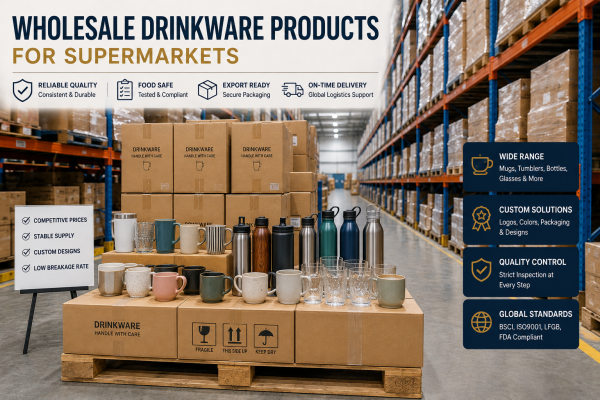
Supermarkets rarely source drinkware directly from a single factory. Instead, they rely on a sophisticated supply chain managed by professional importers and wholesalers. These intermediaries consolidate orders from multiple retailers, manage complex logistics, absorb financial risk, and enforce stringent quality and compliance standards that individual factories cannot manage on a global scale. The "low price" on the shelf reflects the efficiency of this entire system, not just a factory's unit cost.
This might seem counterintuitive. Why would adding a "middleman" make things more efficient? Because sourcing for major retailers is less about a single transaction and more about managing a continuous, high-stakes flow of goods. Let's pull back the curtain and explore how this process truly works, from our perspective on the factory floor.
Why Don't Supermarkets Buy Directly from Factories?
You might think that a multi-billion dollar supermarket chain could easily set up a team to buy directly from a factory like ours. The core problem is that this thinking misinterprets the role of the importer. You assume they are a simple tollbooth adding a markup, but they're actually a risk shield, logistics hub, and financial partner. For a supermarket, trying to replicate this service in-house for a category like drinkware is often more expensive and far riskier than partnering with a professional.
An experienced importer or wholesale drinkware supplier isn't just a reseller. They are a master of managing complexity—a service that is absolutely critical for the high-volume, low-margin world of retail. They provide a buffer that makes the entire drinkware supply chain function smoothly.
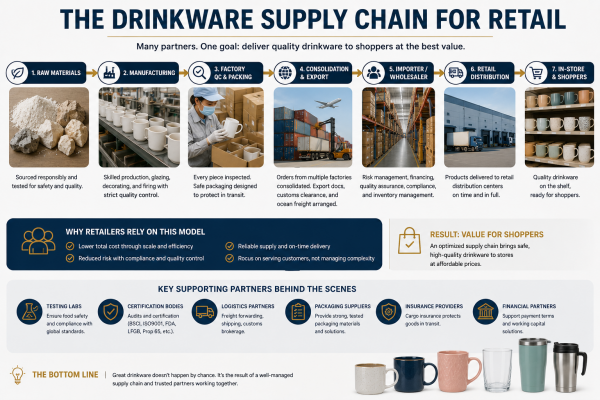
The Importer as a Risk and Logistics Partner
From our position as a ceramic mug supplier for importers, we see firsthand the value they create. They don't just place an order; they build a program. A single supermarket might want 20 different mug designs for the holiday season. Sourcing these might involve three different factories specializing in different materials or decoration techniques.
A professional importer handles this orchestration seamlessly. Here's what that looks like in practice:
- Financial Shield: Importers pay us, the factory, often with a 30% deposit and the balance before shipment. They extend credit terms to the supermarket, which might pay 60 or 90 days after receiving the goods. The importer is financing the entire supply chain, absorbing significant capital risk that neither the factory nor the retailer wants to hold.
- Order Consolidation: That order for 20 mug designs? The importer consolidates them into full container loads (FCL), ensuring the most cost-effective shipping. Trying to ship less-than-container loads (LCL) from multiple factories is a logistical nightmare and dramatically increases freight costs per unit.
- Quality Assurance & Claims: If a shipment has a 2% breakage rate, the importer deals with it. They manage the claim, arrange for credit, and handle the issue with the retailer. A supermarket's procurement team cannot manage thousands of small claims across hundreds of suppliers. The importer provides a single point of accountability.
- Compliance & Testing: The importer understands the specific testing requirements for California's Prop 65, the EU's food-contact regulations, and a dozen other regional standards. They book the lab tests and ensure all documentation is perfect before the product even leaves the port.
Here is a simple breakdown of the roles:
| Task | Sourcing Directly | Working with an Importer |
|---|---|---|
| Financials | You pay the factory upfront. | Importer finances the production cycle. |
| Logistics | You coordinate shipping from multiple factories. | Importer consolidates into efficient FCL shipments. |
| Quality Control | You are responsible for all factory audits and claims. | Importer provides a single point of accountability. |
| Compliance | You must know and manage all regional regulations. | Importer is an expert in global compliance. |
For over 15 years, we've built our business by being a reliable partner to these importers. We focus on what we do best—manufacturing high-quality ceramic mugs—which enables them to do what they do best: managing the complex drinkware supply chain for the world's largest retailers.
What Does 'BSCI Certified' Really Mean for Supermarket Drinkware Sourcing?
Many buyers see a BSCI or ISO9001 certificate and tick a box, thinking, "Great, they're compliant." But this view is dangerously simplistic. A certificate is a snapshot in time, a record of a successful audit. For any factory serious about supplying drinkware products for supermarkets, compliance is a continuous, living system woven into the fabric of daily operations. It’s a significant operating cost, but it's utterly non-negotiable.
A paper certificate doesn't prevent a shipment from being held at customs or a product from being recalled. A deeply integrated compliance system does. This is the difference between passing a test and actually knowing the material.
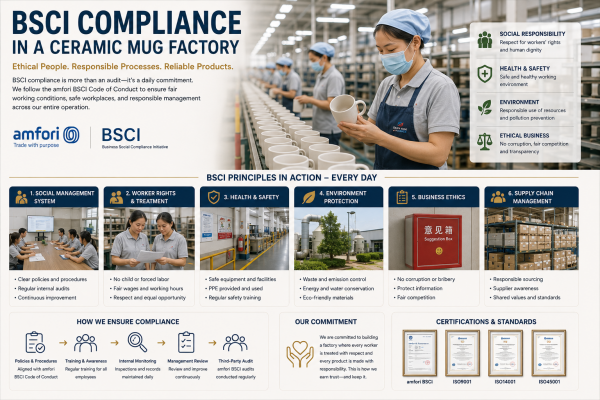
From Audit Day to Every Day
When our importer partners tell us their retail clients are coming to audit, we don't panic. We don't need to stage a "cleanup day." The systems they will audit are the same systems we use to run our business every single day. This is what true compliance looks like for a retail drinkware supplier.
Here’s what "BSCI in practice" means beyond the paper:
- Human Resources Management: It’s not just about paying minimum wage. It's about having transparent systems for calculating overtime, ensuring legally mandated breaks, providing clear employment contracts, and maintaining a workplace free from discrimination or harassment. This reduces employee turnover and improves morale, which directly translates to better, more consistent quality.
- Workshop Management: This covers everything from clearly marked fire exits and regularly tested extinguishers to proper machine guarding and providing personal protective equipment (PPE). It’s about ensuring the air quality in the glazing area is safe and that heavy materials are lifted correctly. A safe worker is a focused and productive worker.
- Material Traceability: This is a cornerstone of our ISO9001 system and a key part of social and safety compliance. We must be able to trace a specific batch of glaze back to its supplier and the associated safety data sheets. This is crucial for creating food-safe ceramic mugs and is the first line of defense against a costly recall due to a material issue. When a supermarket asks for proof that our mugs are lead and cadmium free, we don't just show a test report for one mug; we show them the system that ensures every mug meets that standard.
This level of operational discipline is a primary cost driver. It requires dedicated staff, ongoing training, and investment in infrastructure. But it's also our biggest competitive advantage. It's why professional importers and the supermarkets they serve trust us with large, high-stakes orders. They aren't just buying a ceramic mug; they are buying the assurance that it was made safely, ethically, and in full compliance with global standards.
Where Do Real Cost Savings Come From in a Ceramic Drinkware Manufacturer?
When buyers push for a lower price, they often focus on visible inputs like labor or raw materials. They assume that to source ceramic mugs from China cheaply, a factory must be cutting corners on one of these. The reality, from our perspective as a ceramic drinkware manufacturer, is that the real levers of cost control are nearly invisible to an outsider and have everything to do with manufacturing excellence.
Focusing only on the unit price ignores the hidden factors that truly impact your bottom line. True cost savings come from optimizing the total cost of ownership for drinkware, which is achieved through deep process knowledge and relentless efficiency gains.
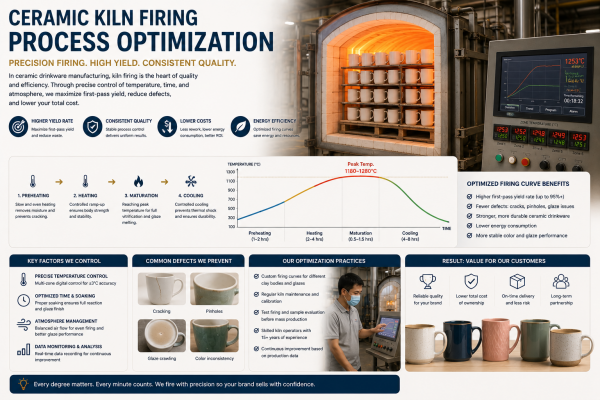
The Invisible Economics of Manufacturing
I remember a new buyer who was fixated on our labor cost per hour. What they didn't understand is that labor is a minor fraction of a mug's final cost. The real drivers are yield, mold efficiency, and material science. A factory that masters these can offer a competitive price without compromising on quality or compliance.
Here are the areas where we focus our energy to control costs:
H3: Maximizing the First-Pass Yield Rate
The yield rate is the single most important metric in ceramics manufacturing. It's the percentage of perfect, sellable products that come out of the kiln in a single run. If we fire 10,000 mugs and 9,500 are perfect, our yield is 95%. Those 500 defective mugs represent wasted materials, wasted labor, and wasted kiln capacity.
- The Impact: A factory with a 95% yield rate has a fundamentally lower cost structure than a factory with an 85% yield. To produce 10,000 good mugs, the second factory has to start with nearly 12,000 units, consuming 20% more resources.
- How We Do It: We achieve high yields through precise control over our kiln firing curves, meticulous glaze formulation to prevent defects like pinholes, and rigorous training for our staff to handle the greenware (unfired clay) carefully.
H3: Strategic Mold Management and Amortization
For a large order of 100,000 mugs, we can't use a single plaster mold; it would wear out. We need a family of dozens of molds.
- The Challenge: Ensuring that mug #1 and mug #100,000 are identical in shape, size, and capacity requires incredible precision in master mold creation and careful management of the production mold lifecycle.
- Cost Control: The cost of creating these molds must be amortized over the entire order. We have developed processes to maximize the number of uses we get from each production mold before it's retired, directly lowering the cost per unit. This is something a small, inexperienced workshop simply cannot manage at scale.
H3: Packaging Engineering for a Brutal Supply Chain
What good is a perfectly made mug that arrives in pieces? Breakage in transit is a massive cost driver. We don't just sell mugs; we sell mugs that arrive safely.
- The Process: Our packaging design isn't an afterthought; it's a core part of the product development. We work with our importer partners to design boxes that pass rigorous drop tests, balancing protection with material cost and container-loading efficiency. Check out our ceramic mug packaging guide for more on this.
- The Benefit: A 1% reduction in breakage can have a bigger impact on your net profit than a 1% reduction in unit price.
This focus on operational excellence is how a professional ceramic drinkware manufacturer provides a competitive price that is sustainable, reliable, and built on a foundation of quality.
How Can You Identify a Truly Capable Ceramic Mug Manufacturer?
In a sea of online directories and trade show booths, every factory claims to have "good quality" and "low prices." So how do you separate a truly capable, professional ceramic mug manufacturer from a trading company or a workshop that isn't ready for prime time? You have to change the questions you ask.
Asking "What is your best price for 10,000 mugs?" will only start a race to the bottom, encouraging suppliers to quote based on unrealistic assumptions or hidden quality cuts. To find a real partner, you need to ask questions that probe their operational capabilities and process discipline.
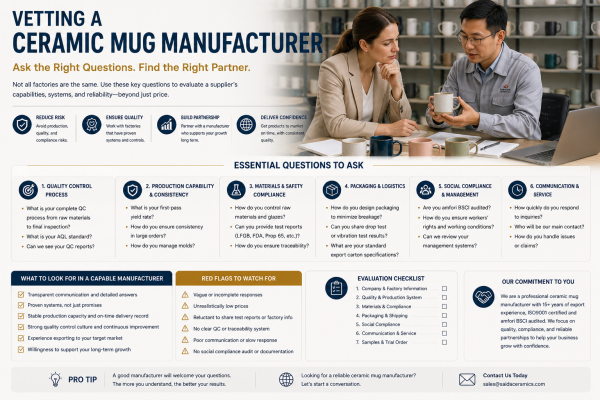
Asking Smarter Questions to Uncover True Expertise
A professional manufacturer will welcome questions about their process. It's a chance for them to demonstrate their expertise. A less capable supplier will likely give vague answers or try to steer the conversation back to price.
When you're vetting a potential new factory partner, try asking these questions instead of just focusing on price:
- "Can you walk me through your complete ceramic mug quality control process for an order of this size?"
- What to listen for: A good answer will mention specific checkpoints: incoming raw material inspection, greenware inspection before firing, post-firing inspection for defects, and pre-shipment inspection. They should be able to tell you their AQL (Acceptable Quality Limit) standards.
- "For a mug with this complex glaze, what is your typical first-pass yield rate?"
- What to listen for: An honest, experienced manager will give you a realistic number (e.g., "For this reactive glaze, we aim for 92-94%"). They might also explain what they do to control variables. A vague "our quality is very good" is a red flag.
- "How do you manage mold consistency and amortization for a 100,000-unit order?"
- What to listen for: Look for answers that mention master molds, the planned number of production molds, and a system for retiring molds after a certain number of uses to prevent "shape creep." This shows they understand the challenges of high-volume consistency.
- "What traceability systems do you have in place for your clay and glazes?"
- What to listen for: They should mention batch coding, supplier documentation, and the ability to link a finished product back to the raw materials used. This is a direct indicator of their ability to guarantee food safety.
These are the kinds of conversations we have with our professional importer partners every day. They use tools like a detailed ceramic mug supplier checklist to vet us, and we welcome it. Asking these questions elevates you from a "price shopper" to a professional buyer and is the fastest way to find a factory that can truly support your growth.
Frequently Asked Questions
What's a typical MOQ for supermarket drinkware orders?
For direct factory production runs intended for supermarkets, the Minimum Order Quantity (MOQ) is often 5,000 to 10,000 units per SKU (Stock Keeping Unit). However, these large orders are almost always placed by importers who may be consolidating demand from several retailers, making the total production run much larger.
Can I source ceramic mugs from China directly for my small e-commerce store?
Yes, it is possible, but you must be prepared to act as your own importer. This means managing international payments, hiring a freight forwarder, handling customs clearance and import duties, and arranging your own third-party quality control. For smaller volumes, it is often more cost-effective to start by working with a domestic wholesale drinkware supplier.
How long does the supermarket drinkware sourcing process take?
From the initial product design brief to the drinkware appearing on supermarket shelves, the entire process typically takes 6 to 9 months. This timeline includes stages for design, sampling, lab testing and compliance verification, mass production, sea freight, and distribution to retail stores.
Is ISO9001 as important as BSCI for supermarket suppliers?
Yes, they are equally important because they address two different critical areas. BSCI (Business Social Compliance Initiative) focuses on social compliance and ethical working conditions. ISO9001 focuses on the quality management system—the processes and procedures that ensure consistent product quality. Major retailers and their importers require suppliers to be strong in both areas.
Conclusion
The path to successful supermarket drinkware sourcing is not a shortcut. It doesn't involve finding a secret, ultra-cheap factory. Instead, it's about understanding that the price on the shelf is the result of a highly optimized, risk-managed supply chain. The most successful sourcing strategies recognize the immense value that professional importers bring in managing finance, logistics, and compliance. The "cost" of this intermediary is, in fact, an investment in stability and scale. As a manufacturer, our role is to be an exceptionally reliable link in that chain, focusing on the manufacturing excellence—yield rates, mold management, and process control—that creates true, sustainable value. This partnership model is what allows quality drinkware products for supermarkets to be made affordable and accessible around the world.
As a 15-year veteran ceramic mug manufacturer serving top importers in the EU and Americas, we understand exactly what it takes to meet the standards of the world's most demanding retailers. If you are a professional importer, a wholesaler, or a large-scale buyer looking for a manufacturing partner who speaks the language of quality and reliability, contact us. Let's discuss how we can build a resilient and competitive drinkware program together.