Struggling to get traction with hotel clients? You present beautiful designs for custom mugs for hotel brands, but the conversation stalls, and you lose out to competitors who seem to have a secret playbook. The problem is that the hospitality industry doesn't buy like retail. This constant rejection is frustrating and costly. It's time to change your approach from being a product pusher to a problem solver.
To successfully sell custom mugs for hotel brands, you must shift your focus from aesthetics to operational durability and supply chain consistency. Prove that your mugs can withstand industrial dishwashing, solve storage challenges with stackable designs, and guarantee brand consistency for years to come. This transforms your pitch from a product sale into a long-term operational solution.
This might sound like a major shift, but it's the core difference between winning a small, one-time order and securing a large, recurring contract. Let's dive into the common mistakes intermediaries make and how you can position yourself as an indispensable consultant for any hotel brand.
Why Do Most Pitches for Custom Mugs for Hotel Brands Fail?
You’ve got a catalog full of stunning mugs and a killer price. You walk into a meeting with a hotel's procurement manager, ready to impress. But instead of excitement, you get polite indifference. Why isn't your beautiful product landing the deal?
The pitch fails because it presents a retail product to an operational business. Hotels aren't just looking for a pretty mug for their rooms. They are looking for a durable, functional asset that lowers their total cost of ownership and withstands the brutal reality of their daily operations.
The Hotel Manager's Real Calculation
When I consult on a hotel project for one of our distributor clients, the first thing I warn them about is the "Cost of Ownership" trap. A hotel manager isn't thinking, "This is a nice-looking mug." They are thinking:
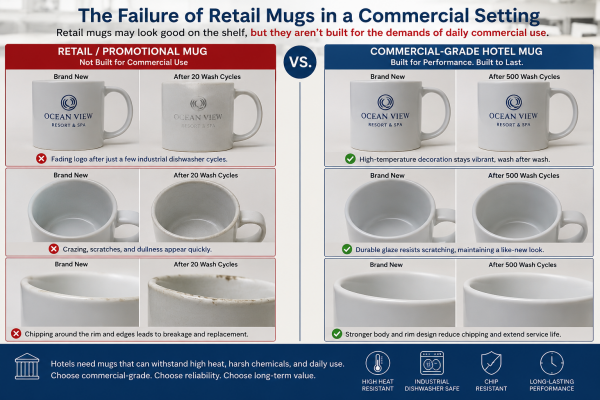
- "How many of these will I have to replace due to chipping in the first six months?"
- "Will the logo fade after a month of high-heat washing, making my brand look cheap?"
- "How much will it cost me in labor and new inventory to constantly replace these inferior products?"
A mug that costs $2 but needs to be replaced three times a year is far more expensive than a $4 commercial-grade ceramic mug that lasts for years. This is the fundamental math that most salespeople miss. They sell on the sticker price, while the hotel buyer purchases based on long-term value and operational cost.
For example, I once worked with a partner trying to win a deal with a 4-star hotel chain. They led with a beautiful, intricate design printed on a standard promotional mug. The procurement manager was unimpressed. He stopped the pitch and asked a simple question: "Can you guarantee this logo will survive 100 cycles in our industrial dishwasher?" My partner was speechless. They had never even considered it. They lost the deal on the spot because they were selling a decoration, not a piece of operational equipment. Hotels need assets, not just accessories. They require hospitality ceramic mugs built for the job.
What's the Single Most Important Question for Hospitality Ceramic Mugs?
If you want to cut through the noise and immediately establish your credibility, you need to lead with what matters most to the hotel operator. It's not about your vast catalog or your flexible design options. There's one question that changes the entire dynamic.
The single most important question is: "Is the logo and glaze proven to be safe for industrial dishwashers?" Answering this question confidently, with proof, is what separates a professional hotel chinaware supplier from an amateur. It shows you understand their biggest operational headache.
The Brutal Reality of a Hotel Dishwasher
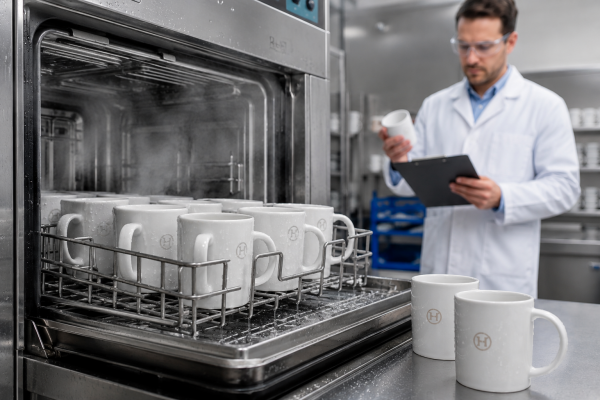
A commercial dishwasher is not like the one in your home. It's an engine of sanitation designed for speed and efficiency. Think of it as a daily torture test for any chinaware.
Here's what a hotel room coffee mug endures multiple times a day:
- Extreme Heat: Water temperatures often reach 82°C (180°F) or higher to meet health and safety standards.
- High-Pressure Jets: Powerful water jets blast away debris, but they also slowly erode low-quality prints and glazes.
- Harsh Detergents: Commercial detergents are highly corrosive to break down grease and sterilize surfaces. They are notoriously tough on printed logos.
A standard promotional mug, often decorated with low-temperature decals or sublimation printing, simply cannot survive this environment. The logo will fade, discolor, or peel off within weeks, making a premium hotel brand look sloppy and cheap.
How to Prove Your Durability
This is where you, as a consultant, can shine. Instead of just saying your mugs are durable, prove it. When we advise our distributor partners, we recommend a simple but powerful test. We produce a sample of the proposed hotel branded mug and tell our partner to give it to the hotel's operations manager with these instructions: "Run this through your dishwasher every day for the next month. Put it to the test."
We can make this offer because we use high-temperature firing techniques. The branding is applied via in-glaze or high-temperature on-glaze decals, which are then fired at over 800°C (for on-glaze) or even 1200°C (for in-glaze). At these temperatures, the decal fuses with the glaze, becoming a permanent part of the mug. It cannot be scratched off or faded by a dishwasher.
Recently, we helped one of our European partners secure a contract with a boutique hotel group. The competitor offered a slightly lower price, but their sample's logo started to fade after just ten wash cycles. Our sample, after 100 cycles, looked identical to the day it was made. That test single-handedly won them the contract, which was worth ten times the initial order value in the long run. Proving you can supply truly dishwasher safe hotel mugs is your greatest sales tool.
How Can You Reframe the Conversation to Win Orders for Custom Mugs for Hotel Brands?
Walking into a sales meeting with a thick catalog and a price list immediately positions you as a commodity vendor. To win high-value hotel contracts, you must elevate the conversation. You need to stop selling and start consulting.
To win these deals, you must ask diagnostic questions about the hotel's operations before you ever show them a product. This reframes the entire discussion from "How much does it cost?" to "How can we solve your operational challenges and protect your brand integrity?"
From Pitching Products to Diagnosing Problems
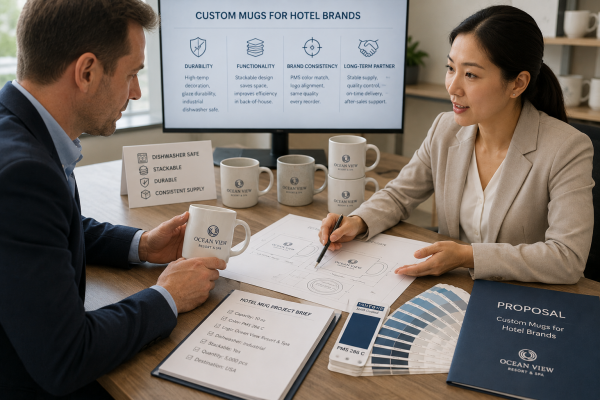
Imagine you start your next meeting not by opening your laptop, but by asking a series of thoughtful questions. You instantly differentiate yourself and show that you understand their world. Your goal is to uncover pain points related to their current chinaware.
Here are the key diagnostic questions we train our partners to ask:
-
"Can you walk me through your team's daily process for collecting, washing, and storing your current mugs?" This question uncovers issues with chipping, breakage, and efficiency. It tells you whether they need a mug with a reinforced rim or a more robust body.
-
"Where are the mugs stored in your back-of-house? Is floor space or shelf space a concern?" This is the perfect lead-in to discuss stackable mugs for hotels. A stackable design can dramatically improve storage density and reduce the risk of accidents, a major operational win that has nothing to do with aesthetics.
-
"Your brand is built on a premium experience. What are your brand's exact Pantone colors, and how important is perfect color consistency for re-orders?" This question shows you care about their brand integrity. It opens the door to discuss your ability to deliver precise color matching and guarantees consistency over time—something a typical trading company can't promise.
-
"What is your approximate annual replacement rate for your current hotel room coffee mugs due to fading, chipping, or breakage?" This question forces the procurement manager to quantify their pain. If they are replacing 30% of their mugs every year, your more durable but slightly more expensive mug suddenly looks like a huge cost-saving opportunity.
By leading with these questions, you are no longer just another supplier of wholesale mugs for hotels. You become a valued partner who is genuinely invested in improving their operations and protecting their brand.
Why Is a Reliable Supply Chain More Valuable Than a Low Price for Ceramic Mugs for Hospitality Brands?
You did it. You leveraged your consulting skills, proved your product's durability, and won the initial order. But the real test—and the real profit—comes six months or two years later when the hotel needs to order more. This is where most suppliers fail and where true partners are made.
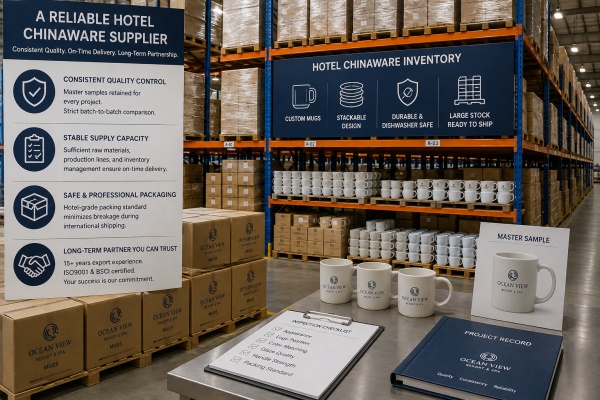
For ceramic mugs for hospitality brands, brand consistency is non-negotiable. The real value you offer isn't just a durable mug; it's a reliable supply chain that guarantees a replacement mug ordered in 2026 will be identical in shape, color, and logo placement to one delivered in 2024.
The Long-Term Consistency Challenge
Delivering an identical product years later is incredibly difficult. It's where most trading companies, who source from various factories based on price, fall apart. True consistency requires deep manufacturing control.
| Challenge | Trading Company Problem | Factory Solution |
|---|---|---|
| Color Matching | The new factory uses different glaze materials or firing curves, resulting in a visible color shift. | We maintain master color panels and use a spectrophotometer to ensure batch-to-batch consistency. |
| Shape & Size | Production molds wear out or the new supplier uses a slightly different mold. The new mugs don't stack with the old ones. | As a 15-year-old factory, we maintain and manage our own molds. We keep detailed records of every product shape. |
| Logo Placement | The decal is applied by a different team, resulting in slight variations in height or centering. | We create detailed production guides and physical jigs for every project to ensure logo placement is precise every time. |
As a factory with over 15 years of export experience, we've built our reputation on this promise. We keep physical master samples from past orders, along with detailed technical files. This institutional knowledge is our guarantee to you and your hotel client. When they need a top-up order, they get an exact match. This is the service that turns a one-time transaction into a decade-long partnership.
Building Your Recurring Revenue Stream
By partnering with a reliable manufacturer, you are not just selling a product. You are selling peace of mind. You become the guardian of the hotel's brand consistency in that product category. This makes you incredibly valuable and difficult to replace.
The hotel no longer sees you as just a supplier; they see you as an essential part of their long-term brand strategy. This locks in a recurring revenue stream for you, as the hotel will continue to place top-up and replacement orders for years. This is the ultimate goal: to move beyond single sales and build a portfolio of loyal, high-value clients in the hospitality sector.
Frequently Asked Questions
What is the best material for custom hotel mugs?
For hotel use, the best materials are high-fired porcelain or stoneware. Both offer excellent durability, resistance to chipping, and great heat retention. Porcelain often provides a more premium, thinner profile, while stoneware can offer a more rustic, robust feel. The key is ensuring it's fired at a high temperature to become fully vitrified and non-porous.
How do I ensure the logo on hotel branded mugs won't fade?
Insist on mugs decorated with high-temperature firing methods. This includes in-glaze or high-temperature on-glaze decals, where the design is fired at over 800°C and fuses with the mug's surface. Always request a sample and perform a dishwasher test (50+ cycles) to verify the claim before placing a bulk order.
Are stackable mugs for hotels really that important?
Yes, absolutely. For many hotels, especially those in dense urban areas, back-of-house storage space is extremely limited. Stackable mugs maximize shelf space, improve organization, and reduce the risk of breakage from unstable stacking. Pitching a stackable design shows you're thinking about their operational efficiency, not just the product itself.
What's the typical minimum order quantity (MOQ) for wholesale mugs for hotels?
MOQs can vary widely. For a truly custom shape and glaze, direct-from-factory orders often start around 3,000 units. For decorating a stock body, the MOQ might be lower, typically 1,000 to 1,200 units. This quantity is necessary to ensure a stable, high-quality production run and consistent color.
Conclusion
The path to successfully selling custom mugs for hotel brands is to fundamentally shift your mindset. Stop selling a pretty product and start providing a robust operational solution. This means leading with durability, proving your claims with real-world tests, and asking consultative questions that uncover deep operational needs. By focusing on industrial dishwasher safety, stackability, and, most importantly, the promise of long-term supply chain consistency, you transform yourself from a simple vendor into a trusted, long-term partner. This is how you win bigger deals that generate recurring revenue for years.
If you are ready to approach the hospitality market as a true consultant, we're here to be your expert manufacturing partner. As a factory with 15 years of experience producing commercial-grade ceramic mugs, we provide our distributor clients with the technical knowledge, production reliability, and long-term consistency they need to win. Contact us today to discuss your next hotel project.