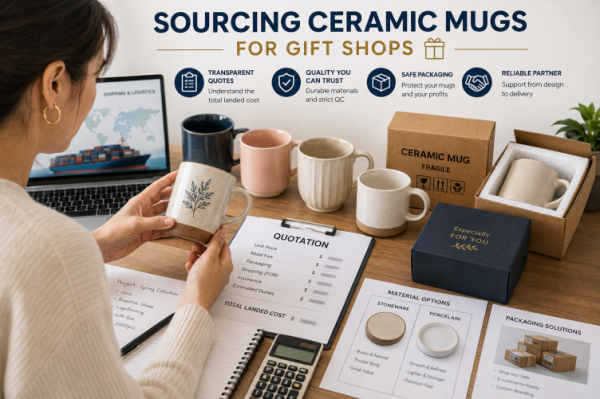
Trying to source ceramic mugs for your gift shop or e-commerce store can feel overwhelming. You get dozens of quotes, and the natural impulse is to pick the one with the lowest unit price. But this is a classic trap that can lead to hidden costs, quality issues, and a shipment that costs you more in the long run. The key is to look beyond the price tag and understand the total landed cost, turning your sourcing process into a strategic business decision.
Gift shops source ceramic mugs by moving beyond the unit price and evaluating the total landed cost. This involves partnering with a reliable ceramic mug manufacturer who provides transparent quotes covering production, custom molds, sampling, packaging, shipping, and insurance. The best sourcing strategy balances quality, risk, and overall profitability.
That’s the short answer. But what does "total landed cost" really mean? And how do you find a supplier who acts like a partner? Let's break down the process I've guided hundreds of buyers through over my 15 years in this industry.
Why Is Focusing on Unit Price a Mistake When You Source Ceramic Mugs?
You've received a quote for $1.50 per mug, while another is $1.80. It seems like a simple choice, right? But this focus on the unit price often hides a minefield of extra expenses that can obliterate your profit margins and cause major headaches down the line.
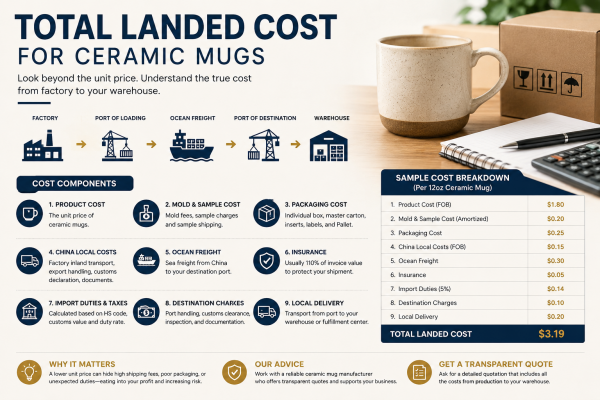
Focusing solely on unit price is a mistake because it ignores the total landed cost for ceramic mugs. This full cost includes not just the mug itself, but also mold fees, shipping, insurance, import duties, and potential losses from breakage, making the "cheaper" option often more expensive overall.
Dive Deeper: The Unit Price Illusion
In my experience, the single biggest mistake new importers make is anchoring on the per-unit price. They see a low number and think they've found a bargain. But a professional buyer knows the unit price is just one piece of a much larger puzzle. The real number you need to focus on is the Total Landed Cost (TLC) — the final cost per unit once it arrives at your warehouse door.
I once had a new client from Germany who was ready to walk away because our unit price was $0.20 higher than a competitor's. I asked him to forward me the other quote. After a quick look, I pointed out that the competitor's quote was based on EXW (Ex Works) shipping terms. This meant he would be responsible for arranging and paying for a truck to pick up the goods from their factory and deliver them to the port in China. That single cost, which was not included in their quote, made their "cheaper" offer significantly more expensive than ours. He’s been our client for five years now.
This scenario is incredibly common. To avoid it, you need a ceramic mug supplier who provides a transparent quotation that accounts for the full picture.
Deconstructing Your Quotation
A good quote is a tool for managing risk. Here’s what should be clearly itemized to calculate your true total landed cost for ceramic mugs:
| Cost Component | "Cheap" Supplier Quote | Transparent Partner Quote | Why It Matters |
|---|---|---|---|
| Unit Price | $1.50 | $1.80 | The starting point, but not the final word. |
| Mold Fee | Not mentioned | $500 (one-time) | For custom ceramic mugs, a hidden mold fee or a cheap, low-quality mold can ruin your project. |
| MOQ | 5,000 units | 2,000 units | A high Minimum Order Quantity ties up your cash flow, even if the unit price is low. |
| Packaging | "Standard box" | Drop-test-safe individual box | Poor packaging leads to breakage. Losing 10% of your shipment to damage makes each surviving mug 11% more expensive. Our ceramic mug packaging guide explains this in detail. |
| Shipping Terms | EXW (Ex Works) | FOB (Free on Board) | EXW leaves you responsible for Chinese domestic logistics, a major hidden cost. FOB means the factory handles it to the port. |
| Insurance | Not included | Included (110% of value) | For a container worth tens of thousands of dollars, shipping without insurance is a gamble you can't afford to take. |
| Estimated Duties | Not provided | Provided HS Code | A good supplier provides the correct Harmonized System (HS) code so you can estimate duties on your end. |
When you look at the full picture, the $1.80 mug from a transparent partner is almost always the more profitable and less risky choice. It’s a core part of any good ceramic mug sourcing guide.
How Does Material Choice Impact Your Bottom Line?
You see terms like "stoneware," "porcelain," and "new bone china" on quotes. Do they really matter? Absolutely. Choosing the wrong one can lead to higher breakage rates during shipping, customer complaints about quality, and a product that feels cheap, even if your design is great.
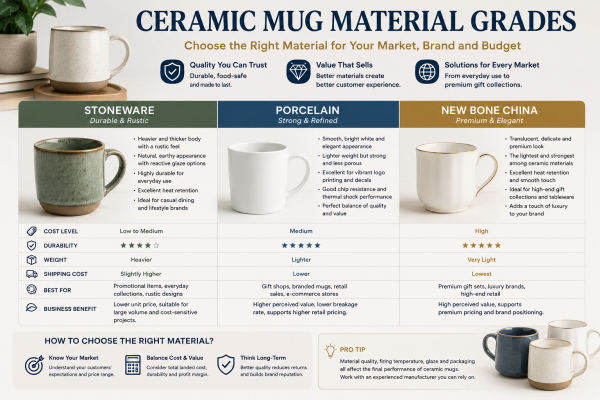
Material choice directly impacts your bottom line by influencing durability, shipping survival rates, and perceived customer value. A slightly more expensive material like high-grade porcelain can reduce breakage and command a higher retail price for ceramic mugs for e-commerce stores, improving your overall profitability.
Dive Deeper: Stoneware vs. Porcelain is a Business Decision
As a buyer, you don't need to be a ceramic engineer. You need to understand how material choices affect your business goals. Over the years, I've found the best way to explain this is to focus on the business outcome, not the technical jargon.
We often send new clients a sample pack with identical designs printed on two different mugs: one standard stoneware and one high-grade porcelain. When they hold them, the decision becomes instant. They feel the difference in weight, see the smoothness of the glaze, and touch the crispness of the finish. They immediately understand which one their customers will pay a premium for.
Here’s a breakdown from a business perspective:
Stoneware
- The Vibe: Heavier, opaque, with a rustic and earthy feel. It’s what you might imagine in a cozy, independent coffee shop.
- The Cost: Generally, the unit cost is lower than porcelain. It's a common choice for large-volume promotional giveaways.
- The Business Risk: Stoneware can be more porous and less dense. This means it might be more prone to chipping during rough, long-haul sea freight if not packaged extremely well. Its weight can also slightly increase shipping costs.
- Best For: Projects where the lowest possible unit cost is the absolute top priority and the brand aesthetic is rustic and handmade.
Porcelain / New Bone China
- The Vibe: Lighter, stronger, and more refined with a bright white base that makes colors pop. It feels premium and has a higher perceived value. This is ideal when you're selling wholesale ceramic mugs with logo to corporate clients or high-end brands.
- The Cost: The unit cost can be 10-20% higher than stoneware.
- The Business Advantage: Because it's fired at a higher temperature, porcelain is less porous and more durable. It's more resistant to chipping and thermal shock (sudden temperature changes). This translates to a lower breakage rate during shipping and fewer customer complaints. Its premium feel allows you to set a higher retail price, easily covering the initial cost difference.
- Best For: Ceramic mugs for gift shops and e-commerce brands where quality, durability, and brand image are paramount.
The choice isn't about "good" vs. "bad" material. It's about matching the material to your market, brand, and risk tolerance.
What Is the Role of a Good Ceramic Mug Supplier?
Are you just looking for a factory to execute an order? Or do you need a partner to help you navigate the complexities of international sourcing? Many importers learn the hard way that a transactional supplier, who just takes your order without question, can lead to costly mistakes and logistical nightmares.
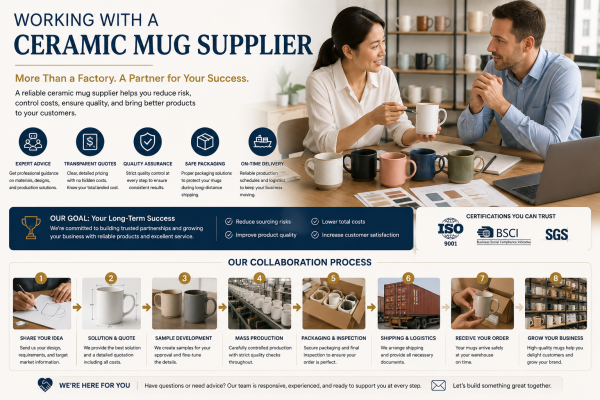
A good ceramic mug supplier acts as a strategic partner, not just a vendor. Their role is to guide you through the entire process, from material selection and cost analysis to ensuring compliance and logistics, ultimately protecting your investment and your brand's reputation.
Dive Deeper: From Order-Taker to Sourcing Partner
The difference between an order-taker and a sourcing partner is the difference between "yes" and "why."
- An order-taker will say "yes" to anything to close the sale. "Can you make it for $1.20?" "Yes." "Can you use this cheap, thin box?" "Yes." They won't warn you that the $1.20 price requires using a low-grade material that will break easily, or that the thin box will result in 20% of your mugs arriving in pieces.
- A sourcing partner will ask "why." When a new buyer comes to me asking for the absolute cheapest option to source ceramic mugs from China, my job isn't to just give them a low number. It's to understand their business. Are they selling online? In a physical gift shop? Who is their end customer? My goal is to prevent them from making a decision that hurts their business in the long run. After 15 years in this role, I've seen the same handful of mistakes derail new ventures. My job is to help you avoid them.
This partnership approach is the most valuable, yet often overlooked, part of sourcing. A detailed ceramic mug supplier checklist should evaluate a supplier's willingness to advise and guide you, not just their price.
Why Certifications Like BSCI and ISO9001 Matter
Many factories list certifications, but buyers often don't understand what they mean for their business. These aren't just logos for a website; they are critical risk-management tools. As a ceramic mug manufacturer with both ISO9001 and BSCI certifications, here's what they mean for you:
-
ISO 9001 (Quality Management System): This certification proves we have a documented, audited, and repeatable process for ensuring quality. It means we have checkpoints from raw material inspection to final packaging. For you, the buyer, this guarantees consistency. The 10,000th mug you order will be the same quality as the first. It dramatically reduces the risk of receiving a bad batch that you can't sell.
-
BSCI (Business Social Compliance Initiative): This is about ethical sourcing. It’s an extensive audit that verifies we adhere to fair labor laws, safe working conditions, and ethical business practices. For any brand selling wholesale ceramic mugs in Europe, the Americas, or other Western markets, this is non-negotiable. It protects your brand from being linked to unethical labor, which can be a PR disaster. Furthermore, most major retailers will refuse to stock products from non-BSCI-compliant factories.
Choosing a certified partner isn't about paying more; it's about buying peace of mind and ensuring your products have access to the widest possible market.
Frequently Asked Questions
How do I get a quote for custom ceramic mugs?
To get an accurate quote, you should provide your potential supplier with a detailed design file (like an AI or PDF), the desired mug shape and capacity, the material you're considering, your target order quantity, and your packaging requirements. A professional supplier will respond with a comprehensive quote that itemizes costs like mold fees and shipping terms.
What is a typical MOQ when you source ceramic mugs from China?
Minimum Order Quantities (MOQs) for custom mugs typically range from 1,000 to 3,000 pieces per design. The exact number can vary based on the complexity of the mug shape, the glaze, and the printing method. Generally, a higher order quantity will result in a lower per-unit cost.
Why is BSCI certification important for a ceramic mug supplier?
BSCI certification is crucial because it verifies a factory's commitment to ethical and social responsibility. For your business, this minimizes brand risk by ensuring your products aren't made with unethical labor. It also grants you access to major retail channels that require social compliance from their suppliers.
How important is packaging for ceramic mugs for gift shops?
It's extremely important. Good ceramic mug packaging serves two critical functions. First, it must be durable enough to protect a fragile product during international shipping and last-mile delivery. Second, for gift shops, the packaging is part of the product's appeal and perceived value, enhancing the customer's unboxing experience.
Conclusion
Ultimately, the secret to successfully sourcing ceramic mugs isn't about chasing the cheapest price; it's about building a reliable, transparent, and profitable supply chain. By shifting your focus from the simple unit price to the total landed cost for ceramic mugs, you can make smarter decisions. Treating material selection as a strategic business choice and, most importantly, choosing a ceramic mug manufacturer who acts as a true partner will protect your investment and set your business up for long-term success.
If you're looking for a partner to help you navigate this process and source high-quality wholesale ceramic mugs for your business, I invite you to reach out. Let's build a quote together that truly works for your bottom line.