Struggling to turn your beautiful ceramic mug inventory into consistent sales? You know your products are great, but they just seem to sit there, not grabbing the attention they deserve. It's frustrating to see valuable shelf space underperform, making you wonder if you need a huge budget to create a display that actually works. The best retail display ideas for ceramic mugs aren't about spending more money; they're about being more strategic and turning your display into a silent, effective salesperson.
The most effective retail display ideas for ceramic mugs are strategies that treat your shelves as a sales tool, not just a storage area. This means using a "hero" section at eye-level for high-margin items, grouping mugs by theme or color to tell a story, leveraging lighting to highlight different glaze finishes, and creating clear visual price tiers to guide customer choice. The goal is to optimize for sales, not just aesthetics.

Now that you know the core principle—strategy over decoration—let's dive deeper. We'll break down the practical methods our most successful boutique and gift shop partners use. These are field-tested approaches that work with limited space and budget, focusing on the two things that matter most: where you place your mugs and what you group them with.
How Can Placement and Grouping Boost Mug Sales?
Have you ever arranged a shelf of mugs only to feel it looks... random? This lack of cohesion can confuse customers, cheapen the perceived value of your products, and ultimately lead to lost sales. Instead of a jumbled collection, a thoughtful layout can actively guide your customers toward a purchase.
The key is to use strategic placement to draw attention to high-value items and smart grouping to make the collection feel curated and intentional. This transforms a passive shelf into an active part of your sales process.
Dive Deeper: From Storage to Storytelling
Over our 15 years as a manufacturer, we've visited hundreds of retail partners. The most successful ones, especially smaller boutiques, master the art of placement and grouping. It's less about having massive, custom fixtures and more about making every inch of a simple shelf work harder.
H3: The "Golden Zone" of Placement
Think of your shelving as having different zones of value. The most valuable real estate in any shop is the space between a customer's waist and their eyes. We've seen partners increase sales of a specific mug by 30-40% simply by moving it from a bottom shelf to this "golden zone."
- Eye-Level is Buy-Level: This is your "hero" section. Place your most unique, high-margin, or best-selling mugs here. This is where you want to make the strongest first impression. A customer's eyes will naturally land here, so this placement silently says, "This is our feature product."
- Reachable Space (Waist to Chest): This is for your "better" products or popular mid-range items. They are easy to pick up and examine.
- Lower Shelves: Use this space for sale items, basics, or bulkier sets. Customers will bend down for a bargain, but rarely for a premium discovery.
- Top Shelves: This area is best for "display only" items—think oversized decorative mugs or pieces that create atmosphere but aren't meant to be handled frequently.
A pattern we see in top-performing gift shop mug displays is a ruthless focus on that eye-level zone. They don't clutter it. They give their best products room to breathe.
H3: Grouping Strategies That Convert
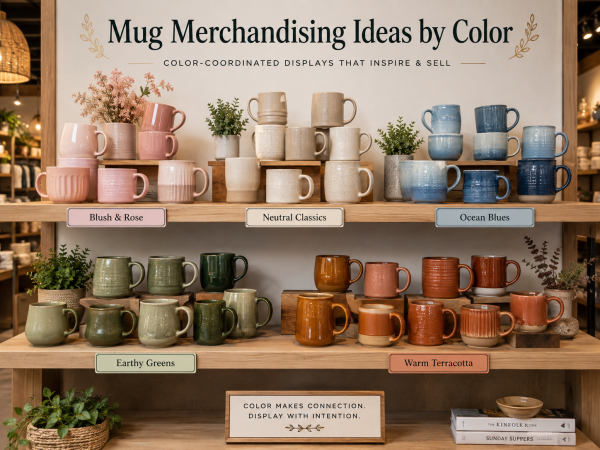
Random mugs create a flea market feel. Curated groups create a boutique experience. Grouping tells a story and helps customers self-identify. Here are some mug merchandising ideas we've seen work wonders:
- Group by Theme: Create a "Morning Coffee Ritual" section with mugs, locally roasted beans, and a small pour-over cone. Or a "Cozy Evening Tea" section with wider mugs, artisanal tea bags, and small honey jars. This helps customers envision using the product.
- Group by Color: Color blocking is one of the simplest and most powerful visual merchandising tools. A stack or row of mugs in graduating shades of blue is instantly eye-catching and looks highly organized. It turns a simple product into a design statement.
- Group by Price Point: Create a clear section for mugs "Under $15." This helps budget-conscious shoppers feel catered to and allows them to browse freely without having to check every price tag.
- Group by Story: Do you have a line of mugs with a unique artist collaboration or a special production story? Group them together with a small sign explaining what makes them special. If you're sourcing custom items, this is a perfect way to showcase them. We often work with partners on Wholesale Ceramic Mugs with Logo that tell their brand's story, and a dedicated display section is crucial for this.
How Do You Use a Display to Signal Price and Value?
You have a range of mugs—some are simple, entry-level pieces, while others are premium, hand-finished works of art. The problem is, when they're all lined up together, they all look like they should cost the same. This kills your ability to sell higher-margin items because you haven't visually justified the higher price.
Your ceramic mug retail presentation is a silent salesperson. You can use spacing, height, and context to communicate that one mug is a standard option while another is a premium investment, guiding customers to the choice that's right for them.
Dive Deeper: The Psychology of Perceived Value
Customers don't just buy a product; they buy what it represents. A display's job is to build that perception of value before they even look at the price tag. We work with clients who source from a Custom Ceramic Mug Manufacturer in China like us to create unique pieces, and their success hinges on displaying that uniqueness effectively.
H3: The "Good, Better, Best" Framework
This classic retail strategy works exceptionally well for mugs. Instead of a uniform display, you create three distinct visual tiers that correspond to your pricing structure.
| Tier | Display Tactic | Psychological Effect |
|---|---|---|
| Good | Stacked high, grouped tightly together in bins or on a low shelf. | "This is a great deal, a practical choice." |
| Better | Lined up neatly in rows on a mid-level shelf with consistent spacing. | "This is the standard, reliable, popular option." |
| Best | Displayed individually, often on a small riser or stand, with ample space around it. May include props or special lighting. | "This is special, a unique find, a premium item." |
A small boutique owner I spoke with in Germany doubled the sales of her €25 mugs by taking them out of the general lineup and giving each its own small wooden block to stand on. That simple change in elevation communicated a massive change in value.
H3: Using Props and Signage to Elevate
Props aren't just for decoration; they are tools for building context.
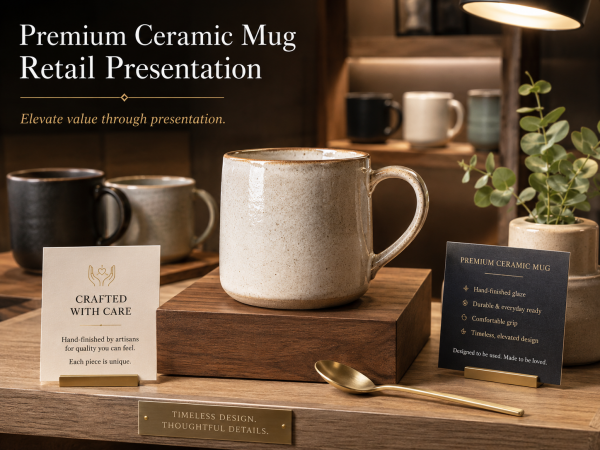
- Risers and Blocks: Using small wooden blocks, acrylic stands, or even a stack of elegant books to create different heights within your display breaks up monotony and draws the eye. The mug with elevation is always perceived as more important.
- Informative Signage: Don't just put a price. For your "Best" items, use a small, well-designed card to tell a story. Is it hand-painted? Made with a special reactive glaze? Does it come from a small batch? A few words can be the difference between a glance and a purchase.
- Cross-Merchandising: As mentioned before, pairing a premium mug with a complementary high-end tea or a beautiful brass spoon justifies its price and increases the average order value. This is a core tenet of effective visual merchandising for mugs.
Can a Mug's Finish Affect Your Retail Display Ideas for Ceramic Mugs?
Do you consider the actual material finish of your mugs when deciding where to place them? Most retailers don't. They put all mugs under the same general store lighting, but this is a missed opportunity. A mug's glaze—whether matte or glossy—interacts with light in dramatically different ways, affecting how premium it appears to a customer.
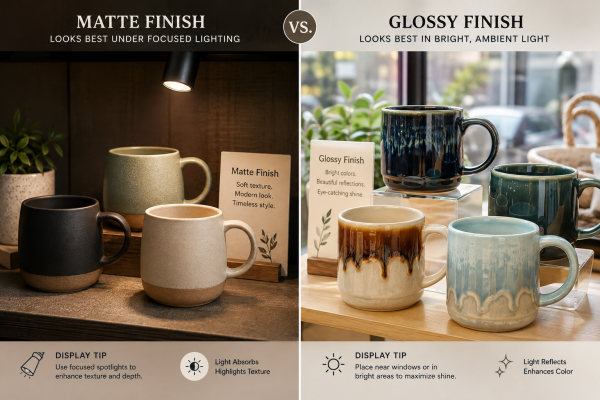
Yes, a mug's finish is a critical factor. Matte glazes absorb light and look most luxurious under focused, direct spotlights, while glossy glazes thrive in bright, ambient, or natural light where they can catch reflections and sparkle.
Dive Deeper: A Manufacturer's Perspective on Light
This is an insight that comes directly from the factory floor. When we conduct our Ceramic Mug Quality Control Process, we use specific lighting conditions to check for imperfections in different glazes. Retailers can use these same principles to their advantage.
H3: Making Matte Finishes Look Luxurious
Matte glazes have a soft, velvety, and modern appearance. They don't reflect light; they absorb it. Under flat, diffuse overhead lighting (like in many retail stores), they can look dull or lifeless.
- The Solution: Use focused lighting. A small, adjustable LED spotlight aimed directly at a display of matte mugs can be transformative. The light creates soft shadows that highlight the mug's form and texture, making it feel sophisticated and tactile.
- Where to Place: This makes matte mugs perfect for interior shelves, nooks, or wall displays where you can control the lighting with a dedicated fixture. They create a moody, high-end focal point away from windows.
H3: Letting Glossy and Reactive Glazes Shine
Glossy and reactive glazes are all about catching the eye with light and reflection. The color and pattern in a reactive glaze can shift and dance as the customer moves past it.
- The Solution: Use bright, ambient light. Place these mugs where they can catch natural light from a window or directly under your brightest overhead lights. The reflections create a sense of vibrancy and energy.
- Where to Place: A ceramic mug shelf display in a storefront window is the perfect home for glossy mugs. As people walk by, the changing light will make the display dynamic and eye-catching. On the shop floor, place them on tables or shelves in the most brightly lit parts of your store.
One key detail for glossy mugs: keep them dust-free! Nothing dulls a shiny, premium product faster than a layer of dust.
What Are Some Effective Mug Merchandising Ideas for a Large Collection?
You love offering variety, but now your shop is overflowing with dozens of different mug styles. The result is a chaotic, cluttered look that overwhelms customers and makes it hard for any single design to stand out. Decision paralysis is real, and a messy display is its primary cause.
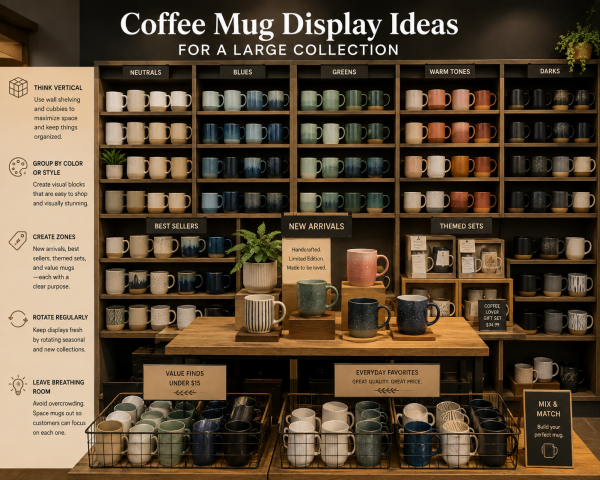
To effectively merchandise a large collection, focus on creating order from chaos. Use vertical shelving to maximize space, create distinct visual "blocks" by organizing mugs by color or style, and implement a rotation strategy to keep the display fresh without showing everything at once.
Dive Deeper: Curation is Your Best Tool
Having a large inventory is a strength, but only if you present it as a curated collection, not a jumble. The goal is to make it easy for a customer to navigate the options and find the perfect mug for them.
H3: Go Vertical with Cubbies and Wall Shelves
When you have a lot of SKUs, floor and table space runs out fast. The solution is to go up.
- Cubby Systems: A simple cube shelving unit (like the IKEA KALLAX) is a gift shop owner's best friend. Each cubby can house a different style, color, or theme. This creates a clean, grid-like look that is incredibly easy for customers to scan. This is one of the most practical and scalable coffee mug display ideas.
- Floating Wall Shelves: Installing several long, floating shelves allows you to create beautiful, repeating rows of mugs. You can organize each shelf by a different color or style, creating a powerful visual impact that draws customers from across the room.
H3: The Power of Rotation and Backstock
You do not need to display every single mug you have in stock at all times. In fact, doing so is often counterproductive.
- Create a "New Arrivals" Section: Have one dedicated, well-lit area where you constantly feature your newest designs. This trains regular customers to always check that spot first.
- Embrace Seasonality: Rotate your display based on the season. Feature warm, earthy tones in the fall; bright pastels in the spring; and bold, festive colors for the holidays. This keeps your shop looking fresh and relevant.
- Safe Backstock: Keep the rest of your inventory safely stored. When we ship to our partners, we follow strict Export Packaging Standards for Ceramic Mugs to ensure they arrive safely. Use that same care for your backstock, keeping it organized so you can easily pull items for rotation. A well-organized stockroom is the secret weapon behind a clean, curated sales floor.
By using these organization and rotation principles, you can offer a huge variety without creating a stressful shopping experience.
Frequently Asked Questions
How often should I change my mug display?
We recommend a minor refresh every 2-3 weeks and a major change every 4-6 weeks or with the change of seasons. A minor refresh could be as simple as swapping the "hero" mug or changing a color grouping. This keeps the display looking fresh for repeat customers without requiring a complete overhaul.
What's the biggest mistake in displaying ceramic mugs?
The biggest mistake is prioritizing aesthetics over sales strategy. A beautiful display that doesn't highlight your high-margin items, guide customer flow, or communicate value is a failure. Always start with the commercial goal, then use design to achieve it.
Can I mix mugs with other products on the same display?
Absolutely! This is called cross-merchandising and it's highly effective. Pairing mugs with complementary items like coffee, tea, biscuits, books, or cozy blankets creates a lifestyle story. This not only makes the mug more desirable but also increases the potential for a larger sale.
How can I make inexpensive mugs look more appealing?
Use the power of grouping and presentation. Instead of selling them individually, bundle three inexpensive mugs together with a ribbon for a "starter set" price. You can also use the "Good, Better, Best" model, placing them in a clean, organized stack or bin that communicates "great value."
Conclusion
Transforming your retail display ideas for ceramic mugs from simple storage into a powerful sales engine doesn't require a massive budget or a design degree. As we've seen with our most successful retail partners, it comes down to a few core principles: focus on sales, not just beauty; be strategic with placement and grouping; use your display to visually communicate price and value; and leverage the physical characteristics of the mugs themselves. By treating your display as a tool and making deliberate, sales-focused choices, you can make your shelves work harder, improve inventory turnover, and increase revenue per square foot.
If you are looking for unique, high-quality ceramic products to feature in your newly strategized display, a reliable manufacturing partner is key. I recommend reviewing a Ceramic Mug Supplier Checklist to ensure you're sourcing products that will not only look great but also meet the quality standards your customers deserve.