Sourcing the right coffee shop mug feels like it should be simple, but your profit margins tell a different story. You're likely wrestling with damaged shipments, complaints about chipping from your cafe clients, and the constant, nagging pressure to find an even cheaper supplier. This comprehensive coffee shop mug buying guide is my answer to that pressure, built on 15 years of helping wholesalers avoid the hidden traps that quietly destroy profitability.
A successful coffee shop mug buying strategy shifts focus from the initial FOB price to the total cost of ownership. This means prioritizing commercial-grade durability, robust packaging, and a supplier's proven ability to manage supply chain risks. Choosing a partner who understands these factors is more critical than saving a few cents per unit on the purchase order.
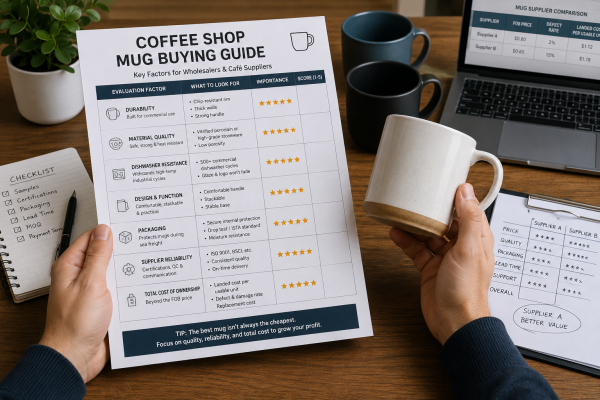
I've spent over a decade in this industry, and the story is always the same. The most successful wholesalers aren't the ones who find the cheapest mug. They're the ones who understand that procurement is risk management. Let's break down the common mistakes I see every day and how you can turn them into a competitive advantage.
Is Focusing on FOB Price Destroying Your Profit Margin?
You get two quotes. Supplier A is $0.80 per mug. Supplier B is $0.65. It feels like a no-brainer, right? But what happens when 15% of Supplier B's shipment arrives chipped or broken? The real cost of that "cheaper" mug suddenly isn't so cheap.
Focusing only on the FOB price is one of the most dangerous illusions in sourcing. The true metric you must track is the "landed cost per usable unit." This figure includes the unit price, shipping, duties, and subtracts the value lost to defects, damage, and replacements.
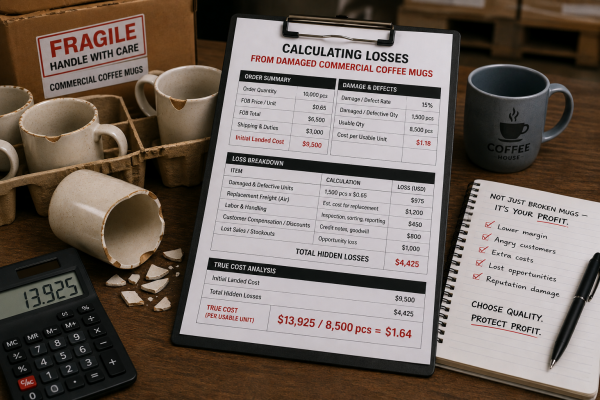
Let's dive into the real math. Overlooking this is where I see most businesses bleed money without even realizing it.
H3: The Simple Math of Total Cost
Let's run a scenario for an order of 10,000 mugs:
| Metric | Supplier A (Higher Price) | Supplier B (Lower Price) |
|---|---|---|
| FOB Price/Unit | $0.80 | $0.65 |
| Total FOB Cost | $8,000 | $6,500 |
| Shipping & Duties | $3,000 | $3,000 |
| Initial Landed Cost | $11,000 | $9,500 |
| Damage/Defect Rate | 2% (200 units) | 15% (1,500 units) |
| Usable Units | 9,800 | 8,500 |
| True Cost per Usable Unit | $1.12 | $1.18 |
As you can see, the "cheaper" supplier ends up costing you $0.06 more for every single mug you can actually sell. Over a year, this difference can add up to tens of thousands of dollars in lost profit. Supplier A, with their better packaging and more rigorous ceramic mug quality control, delivered a more profitable outcome despite the higher initial price.
H3: The Ripple Effect of Poor Quality
The cost doesn't stop at broken units in the container. Consider these downstream expenses:
- Labor Costs: Your team has to spend time unboxing, inspecting, sorting, and reporting the damage. That's time they could be spending on fulfilling orders.
- Reputation Damage: When your coffee shop clients receive defective products, it damages their trust in you. They don't care about your sourcing problems; they just know you sent them unusable inventory.
- Stockouts: High damage rates can lead to unexpected stockouts, causing you to miss sales opportunities and potentially lose clients to competitors who can deliver reliably.
A trustworthy supplier isn't just selling you a mug; they're selling you peace of mind. Their expertise in secure packaging for commercial coffee mugs is a direct investment in your bottom line.
Are You Mistaking Retail Mugs for Commercial Coffee Shop Mugs?
I often get requests from new buyers who send me photos of thin, delicate mugs they found in a department store. They love the aesthetic, but they're fundamentally misunderstanding the product's job. A cafe mug is a piece of industrial equipment, not just a pretty cup.
The primary mistake is judging a coffee shop mug by retail standards. A mug that's perfect for a home kitchen will crack, chip, and fade within weeks in a commercial environment. It must be built to withstand industrial dishwashers, constant stacking, and the bumps and bangs of a busy service.
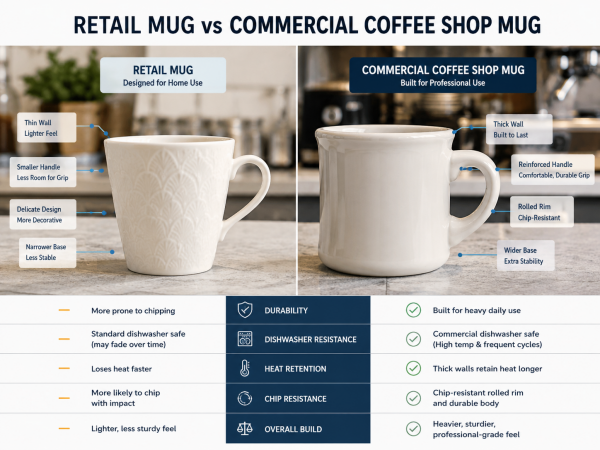
Let's explore what separates a true commercial-grade ceramic mug from a retail look-alike and why this distinction is crucial for your business.
H3: The Anatomy of a Durable Commercial Mug
When we manufacture durable ceramic mugs for cafes, we focus on features that directly address the harsh environment they will live in. These aren't just buzzwords; they are specific engineering choices that impact longevity and safety.
- Vitrified Ceramic Body: The mug is fired at a very high temperature (typically above 1200°C or 2192°F). This process makes the ceramic non-porous, meaning it absorbs less than 0.5% water. For your client, this prevents the mug from harboring bacteria, absorbing old coffee flavors, and cracking due to thermal shock (e.g., going from a hot dishwasher to a cold countertop).
- Reinforced Rolled Rim: The lip of the mug is the most vulnerable point for chipping. A well-made commercial mug has a thicker, rolled edge that provides extra strength against impacts from stacking and handling.
- Thicker Walls & Base: This isn't just for heft. Thicker walls provide better heat retention, keeping the coffee hot for the customer. A heavier, flatter base provides stability, making the mug less likely to tip over.
- Industrial-Grade Glaze: The glaze on a commercial mug needs to resist two things: scratching from cutlery and chemical erosion from high-potency detergents in commercial dishwashers. A weak glaze will quickly develop a network of fine scratches ("crazing") and lose its sheen.
Here’s a simple comparison:
| Feature | Retail Mug | Commercial Coffee Shop Mug | Business Value |
|---|---|---|---|
| Body Porosity | High (>3%) | Low (<0.5%) | Hygienic, resists cracking |
| Rim | Thin, straight | Thick, rolled | Chip-resistant |
| Dishwasher Rating | ~50 home cycles | ~500+ commercial cycles | Prevents logo fading, maintains appearance |
| Wall Thickness | Thin (2-3mm) | Thick (4-6mm) | Better heat retention, more durable |
Choosing the right type of mug isn't about being picky; it's about protecting your client's investment and your own reputation as a quality supplier. When you get samples, don't just look at them. Feel the weight, tap the rim, and ask the supplier for the technical specs. You can use our ceramic mug supplier checklist to make sure you ask the right questions.
Is Your Sourcing Strategy Just Buying, or Is It Managing Risk?
A new client once told me his procurement process was "find the lowest price on Alibaba and hope for the best." He was only half-joking. This approach leaves your business completely exposed to risk. You're not just placing an order; you're trusting a distant partner with your money, your inventory, and your reputation.
A smart sourcing strategy for a coffee shop mug isn't about buying; it's about actively managing risk. This means you stop looking for a supplier and start looking for a partner—one whose processes, certifications, and expertise reduce your exposure to costly problems down the line.
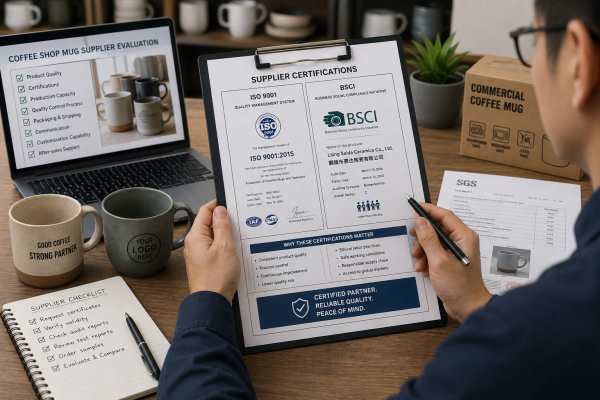
You buy certainty by verifying claims and understanding what different documents and processes actually mean for your business. It’s about asking the right questions before a single dollar is spent.
H3: Decoding Certifications like BSCI and ISO9001
Certifications can feel like alphabet soup, but they are crucial risk management tools. When I talk to clients, I explain what they really mean for a coffee shop mugs wholesale business.
- ISO 9001 (Quality Management System): This isn't a product certification; it's a process certification. It means the factory has a documented, repeatable system for producing goods and handling issues. For you, this translates to consistency. An ISO 9001 certified factory is far more likely to produce the exact same high-quality mug on your fifth order as they did on your first. It's your insurance against "quality fade."
- BSCI (Business Social Compliance Initiative): This focuses on social and ethical standards—worker rights, safety, and fair hours. While this is an ethical imperative, it's also a powerful commercial tool. For you, this means market access. Many large European retailers and corporate clients will not even consider a product unless it comes from a BSCI-compliant supply chain. Having this certification opens doors to higher-value clients.
Don't just take a supplier's word for it. Ask for the certification documents and verify their validity and expiration dates. A reliable partner will provide these without hesitation.
H3: Turning Customization into a Strength
Many wholesalers want to offer custom coffee shop mugs. This introduces another layer of risk. Will the logo fade? Will the color match the brand guidelines?
This is where a supplier's expertise becomes invaluable. A partner, not just a supplier, will consult with you on the best customization method for commercial use.
- Decal Firing: For complex, multi-color logos, a high-temperature fired decal is best. The logo is printed on special paper, applied to the mug, and then fired in a kiln. This fuses the design under the glaze, making it as durable as the mug itself. It's perfect for
wholesale ceramic mugs with logo. - Pad Printing: Good for simple, one or two-color designs. It's faster and cheaper, but may not be as durable as a fired decal unless a strong, specialized ink is used.
- Engraving/Etching: This provides a premium, permanent design that can't wear off. It's a great upsell for high-end cafes.
Your supplier should be able to explain the pros and cons of each method in the context of commercial use, helping you guide your clients to a choice that looks great and lasts long.
Frequently Asked Questions
How do I test the durability of a coffee shop mug sample?
Perform a simple "knock test" by gently tapping the rim with a metal spoon; it should produce a clear, high-pitched ring, not a dull thud. For a more rigorous test, try pouring boiling water into a refrigerated mug to check for thermal shock resistance. Finally, run it through your most powerful dishwasher multiple times to check for glaze or logo fading.
What's a good defect rate for a bulk order of commercial coffee mugs?
For a high-quality supplier specializing in commercial coffee mugs, the acceptable defect rate (including shipping damage) should be under 2%. Anything higher, especially in the 5-10% range, indicates a significant problem in either the manufacturing process or the packaging solution, and it will severely impact your landed cost per usable unit.
Can you put custom logos on durable ceramic mugs for cafes?
Absolutely. The key is to use a method suitable for commercial use. High-temperature decal firing is the gold standard, as it fuses the logo into the glaze, making it scratch-resistant and dishwasher-safe. Simple pad printing might not hold up to industrial detergents, so always confirm the durability of the customization method with your supplier.
What is the difference between stoneware, porcelain, and bone china for coffee shop mugs?
Stoneware is thick, opaque, and great for a rustic feel. Porcelain is fired at a higher temperature, making it non-porous, whiter, and more durable than stoneware—it's the industry standard for wholesale coffee shop mugs. Bone china includes bone ash, making it lightweight, translucent, and very strong, but it's typically a more premium, expensive option.
Why is a reinforced rim important for commercial use?
The rim is the point of most frequent impact—against other mugs during stacking, against portafilters, and during washing. A standard thin rim is the first place to chip. A thicker, rolled, or reinforced rim dramatically increases the mug's lifespan in a busy cafe, reducing replacement costs for your client and complaints for you.
Conclusion
The path to a profitable mug business isn't paved with the lowest FOB prices. It’s built on a smarter approach to sourcing. By shifting your focus from the initial price to the total cost of ownership, you can protect your margins and build a reputation for reliability. Remember the key takeaways from this coffee shop mug buying guide: calculate the landed cost per usable unit, demand true commercial-grade features, and treat your sourcing strategy as a form of risk management. Your clients will thank you, and your bottom line will prove you made the right choice.
If you are a wholesaler or e-commerce seller tired of the risks and ready for a dependable manufacturing partner, my team and I are here to help. With 15 years of experience and a deep understanding of what makes a coffee shop mug successful, we can help you build a profitable and reliable product line. Let's talk about your next project.