Struggling to win contracts with restaurant chains, or dealing with complaints about breakage from your existing clients? Many wholesalers find themselves in a race to the bottom on price, only to find it erodes their profits and reputation. The solution lies in shifting the conversation from unit cost to the total cost of ownership, a strategy that positions you as a valuable partner, not just another supplier.
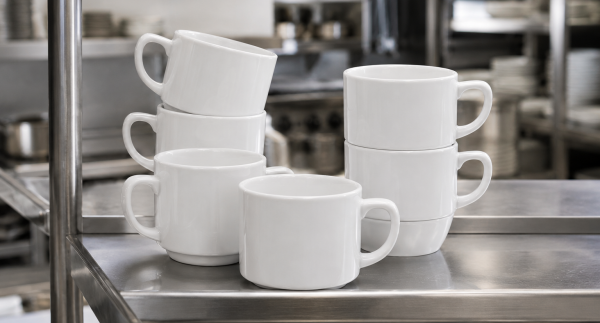
The best way to choose coffee mugs for restaurant chains is to prioritize long-term durability and operational efficiency over the lowest initial unit price. This means selecting restaurant-grade mugs made from reinforced porcelain, which are specifically engineered to withstand thermal shock, chipping, and thousands of commercial dishwasher cycles, ultimately lowering the total cost of ownership.
This approach might seem counterintuitive when your client is focused on their budget. However, as we'll explore, guiding them toward a smarter investment is the key to building long-term, profitable relationships. Let's dive into why the cheapest mug is often the most expensive one in the long run.
Why Does Focusing Only on Price Hurt Your Business?
Are you constantly being asked for lower and lower prices on wholesale coffee mugs? You might win the order, but a few months later, the client complains about high breakage rates. This isn't just bad for them; it's actively damaging your reputation as a reliable supplier.
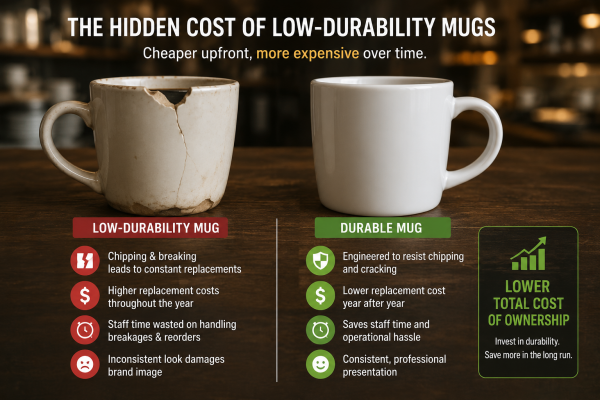
Focusing solely on the initial price tag often means sourcing low-durability mugs. For a restaurant, this translates directly into higher operational costs due to frequent replacements, inconsistent brand presentation with mismatched mugs, and ultimately, dissatisfaction with you as their supplier.
The Vicious Cycle of Low-Price Sourcing
In my 15 years of exporting hotel and restaurant ceramic mugs, I've seen this pattern play out time and again. A wholesaler in South America, keen to supply a national coffee shop chain, focused everything on beating his competitors' price per unit. He sourced standard ceramic mugs that looked great on day one.
Six months later, his client was furious. They had experienced a breakage and chipping rate of over 30%. Their cost calculations were destroyed. They had to place an urgent, expensive air-freight replacement order, and the new mugs didn't perfectly match the old ones, making their cafés look inconsistent. The wholesaler lost the contract at the next review period.
Contrast this with a client in Europe. She was also bidding for a large chain. Instead of leading with price, she led with a discussion about operational costs. She presented two options: a standard mug and a slightly more expensive commercial porcelain mug.
She explained the reinforced porcelain option was specifically designed for high-intensity use. The chain chose the more durable option. A year later, their replacement rate was under 5%. They expanded the contract with her. She made a higher margin, and the client was happier. The difference wasn't the price; it was the conversation.
The True Cost of Ownership
When a restaurant buys a mug, the sticker price is just the beginning. The Total Cost of Ownership (TCO) is a much more important metric.
Here’s a simplified breakdown comparing cheap vs. durable mugs over one year for a chain needing 1,000 mugs:
| Cost Factor | Standard Mugs | Restaurant-Grade Mugs |
|---|---|---|
| Initial Purchase | $2,000 | $3,500 |
| Annual Breakage/Replacement | 30% | 5% |
| Annual Replacement Units | 300 | 50 |
| Annual Replacement Cost | $600 | $175 |
| Annual Admin & Shipping | $200 | $50 |
| Total Cost After 1 Year | $2,800 | $3,725 |
| Total Cost After 2 Years | $3,600 | $3,950 |
| Total Cost After 3 Years | $4,400 | $4,175 |
As you can see, the "cheaper" option becomes significantly more expensive by the second year, not to mention the intangible costs of staff dealing with broken items and inconsistent branding. Presenting this kind of analysis changes your role from a simple order-taker to a strategic procurement advisor.
What Makes a Mug a Good Coffee Mug for Restaurant Chains?
You see words like "durable" and "high-quality" on every supplier's website. But these terms are meaningless without specifics. How can you, as a wholesaler, confidently assess if a product can actually handle the brutal environment of a restaurant kitchen and dining room?
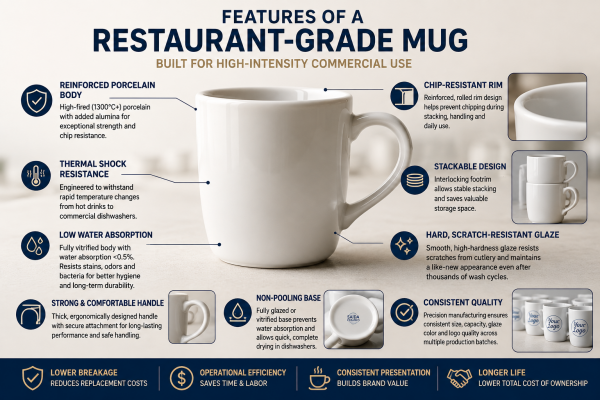
The best coffee mugs for restaurant chains are defined by specific, verifiable characteristics. The selection hinges on the material (like reinforced porcelain), the glaze hardness, and operational design features like stackability and a non-pooling base. These are not just buzzwords; they are features that directly impact a restaurant's bottom line.
Material Matters Most: Reinforced Porcelain vs. Standard Ceramic
The single most important factor determining a mug's lifespan in a commercial setting is its body material. While many mugs are simply called "ceramic," there are huge differences.
For restaurant use, you should be looking for reinforced porcelain.
- What it is: Reinforced porcelain (or fortified porcelain) is a type of vitrified ceramic fired at extremely high temperatures (typically 1300°C or higher). It includes additives like alumina, which significantly increases its mechanical strength and chip resistance.
- Why it's better:
- Chip Resistance: The dense, vitrified body is far less prone to chipping on the rim and handle, which are the most common points of failure when mugs are stacked, knocked, and loaded into dishwashers.
- Thermal Shock Resistance: A restaurant mug goes from holding a boiling hot espresso to being blasted with hot water in a commercial dishwasher multiple times a day. Standard ceramics can develop micro-cracks from this thermal stress, leading to failure. Reinforced porcelain is built to withstand these rapid temperature changes.
- Low Porosity: Because it's vitrified (turned glass-like), it absorbs almost no water (typically <0.5%). This prevents it from absorbing stains, odors, and bacteria, making it more hygienic. It also ensures the glaze won't craze (form a network of fine cracks) over time.
When sourcing, you should ask manufacturers for specifications on the material type and firing temperature. Proper ceramic mug quality control starts with verifying these fundamental material properties. While standard stoneware or earthenware mugs are perfect for home use or promotional giveaways, they are simply not engineered for the demands of a restaurant chain.
Design for Operations: It's More Than Just a Vessel
Beyond the material, the physical design of commercial coffee mugs plays a critical role in daily operations.
- Stackability: Shelf space in a commercial kitchen is prime real estate. Stackable coffee mugs, often designed with a special footrim that nests into the mug below it, are essential. They allow staff to store dozens of mugs safely and efficiently in a small footprint, reducing clutter and the risk of them toppling over.
- Handle Durability: The handle is a major weak point. Look for mugs where the handle is thick, ergonomically sound, and securely attached to the body. During production, we pay extra attention to ensuring a strong bond at these joints to prevent them from snapping off during washing or use.
- Fully Glazed & Non-Pooling Base: Turn a cheap mug over. You'll often find an unglazed, porous footrim that absorbs dirty water in the dishwasher. A well-designed dishwasher safe ceramic mug for commercial use will have a fully glazed or highly vitrified, smooth base. Better still, it will be slightly concave or have channels to allow water to drain away completely, so staff don't have to manually dry each mug.
These might seem like small details, but when you multiply them by hundreds of mugs being washed and stored dozens of times a day, they add up to significant savings in labor and replacement costs.
How Can You Present Value Beyond Price to Your Clients?
Your restaurant chain client just sent an RFQ asking for a price on 5,000 mugs. The immediate temptation is to send back a price list. But this puts you in a direct price war with every other supplier. How do you break this cycle and elevate the conversation?
You can shift the entire dynamic by replacing a simple price list with a "value framework" or a guided selection process. This tool moves the conversation from "how much per piece?" to "which features will deliver the lowest long-term operational cost and best brand experience for your chain?"

Building Your Selection Framework
Instead of just sending a quote, provide a simple consultation tool. It can be a checklist or a comparative table that you walk through with your client. This demonstrates your expertise and focuses the discussion on what truly matters to their business.
Here's an example of a framework you could use:
Mug Evaluation Checklist for Restaurant Chains
| Feature | Low-Cost Option (Standard Ceramic) | High-Value Option (Commercial Porcelain) | Impact on Your Business |
|---|---|---|---|
| Material Body | Earthenware/Stoneware | Reinforced Porcelain | Chip resistance, thermal shock durability. |
| Glaze Hardness | Softer, prone to scratching | Hard, scratch-resistant | Prevents unsightly gray marks from cutlery. |
| Stacking Design | None or unstable | Interlocking footrim | Saves space, reduces breakage from falls. |
| Base Finish | Unglazed, porous | Fully vitrified/glazed | More hygienic, faster drying from dishwasher. |
| Breakage Expectancy | High (15-30%/year) | Low (<5%/year) | Drastically reduces annual replacement cost. |
| Brand Consistency | Color/logo may vary | High batch-to-batch consistency | Ensures every restaurant looks the same. |
Using a tool like this helps the client see why one mug costs more than another. You're not just selling a product; you're selling a solution to their operational headaches. The wholesalers who get long-term contracts are the ones who discuss replacement cycles, not just landing costs.
The Power of Consistent Branding
For a restaurant chain, brand consistency is non-negotiable. The color of the mug, the precision of the logo, and the overall feel must be identical across all their locations, whether they have 10 or 1,000 branches.
This is where your role as a value-added supplier becomes critical. When discussing custom logo restaurant mugs, you can highlight:
- Color Matching: Explain your factory's ability to match Pantone colors precisely and maintain that color across multiple production runs, even years apart.
- Logo Durability: The logo isn't just printed; it's fired onto the mug, becoming a permanent part of the glaze. This ensures it won't fade or peel after hundreds of dishwasher cycles, unlike surface-level prints. You can request documentation on decal quality and firing processes from your manufacturer.
- Quality Control: Emphasize that your supply chain has rigorous quality checks to ensure every mug in a shipment meets the exact specifications for size, shape, and color. This is a core part of providing reliable custom ceramic mugs with logo.
By focusing on these points, you show the client you understand that the mug is part of their brand identity. It's a tangible piece of their customer experience, and you are the partner who can protect and enhance it.
Frequently Asked Questions
What exactly is reinforced porcelain?
Reinforced porcelain is a type of high-grade ceramic fired at very high temperatures and fortified with minerals like alumina. This process creates a dense, non-porous, and exceptionally strong material that is highly resistant to chipping and thermal shock, making it ideal for heavy commercial use.
How important is a stackable design for restaurants?
It's extremely important. Stackable coffee mugs save valuable shelf space in busy kitchens and service areas. A good stacking design is also more stable, reducing the risk of mugs falling and breaking, which saves money and improves staff safety.
Are these commercial-grade mugs truly dishwasher safe?
Yes, but there's a difference. A home "dishwasher safe" mug might handle a few hundred cycles. A true dishwasher safe ceramic mug for commercial use is designed to withstand thousands of cycles in high-temperature, high-pressure commercial dishwashers without the glaze fading, cracking, or the logo deteriorating.
Can I get custom logos on smaller wholesale orders?
This depends on the manufacturer. At our factory, we have flexible processes to support wholesalers. While larger orders are more cost-effective, we can often accommodate smaller runs for custom logo restaurant mugs, especially for clients testing a new design or supplying a smaller chain. It's always best to discuss your specific needs.
What is a realistic breakage rate for restaurant-grade mugs?
For high-quality commercial porcelain mugs used in a typical restaurant environment, a well-managed operation should see an annual breakage and loss rate of under 5%. In contrast, standard, non-commercial ceramic mugs can easily see rates of 20-30% or even higher, leading to significant replacement costs.
Conclusion
Ultimately, selecting the right coffee mugs for restaurant chains is a strategic decision that goes far beyond the initial price tag. As a wholesaler, your expertise is your greatest asset. By guiding your clients away from the false economy of cheap ceramics and toward the long-term value of durable, operationally efficient products like reinforced porcelain, you change the nature of your relationship. You become an indispensable partner invested in their success, not just a line item on an invoice. This focus on Total Cost of Ownership reduces their hidden costs, protects their brand, and secures more profitable, sustainable business for you.
If you're a wholesaler ready to offer real value to restaurant chains, let's talk. Contact us to discuss how our selection of wholesale coffee mugs for restaurants can help you build stronger, more profitable client relationships.