Struggling to find the perfect country for your mugs? The options seem endless, and a wrong choice can cost you time and money. What if you're asking the wrong question?
The "best" country isn't one place. It's about finding the right fit for your specific needs. The best choice depends on your order volume, design complexity, quality standards, and budget. It is a trade-off, not a simple ranking.
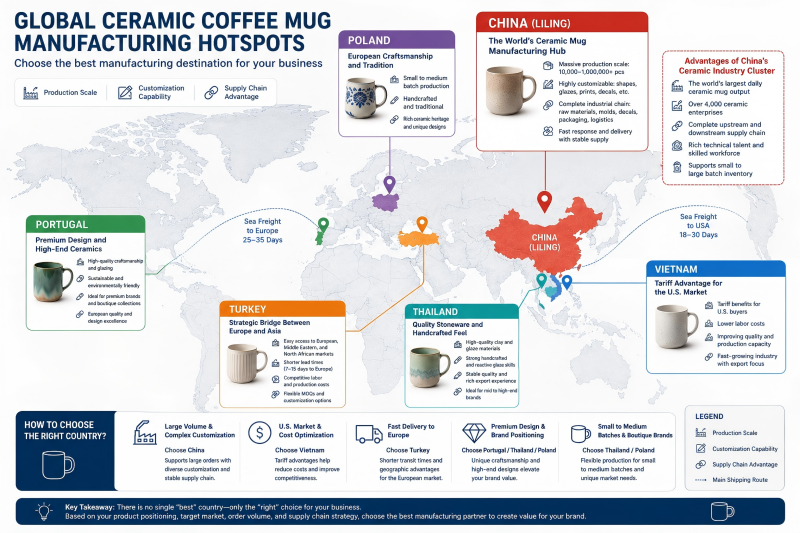
As an export manager for a ceramic factory for over 15 years, I get this question almost every day. Buyers want a simple answer, but the reality is more complex. The goal isn't to find the "number one" country, but to find the perfect partner for your business. Let's break down how to think about this so you can make a confident decision. We will shift the focus from "where" to "how."
What's More Important Than the Price Per Mug?
You have received several quotes, but one seems too good to be true. Low unit prices are tempting, but hidden costs can quickly erase those savings. This can lead to budget overruns and frustration.
Look beyond the unit price. You must consider Minimum Order Quantity (MOQ), tooling costs for custom molds, communication efficiency, and shipping logistics. These factors often have a much larger impact on your total cost and project success than the price of a single mug.
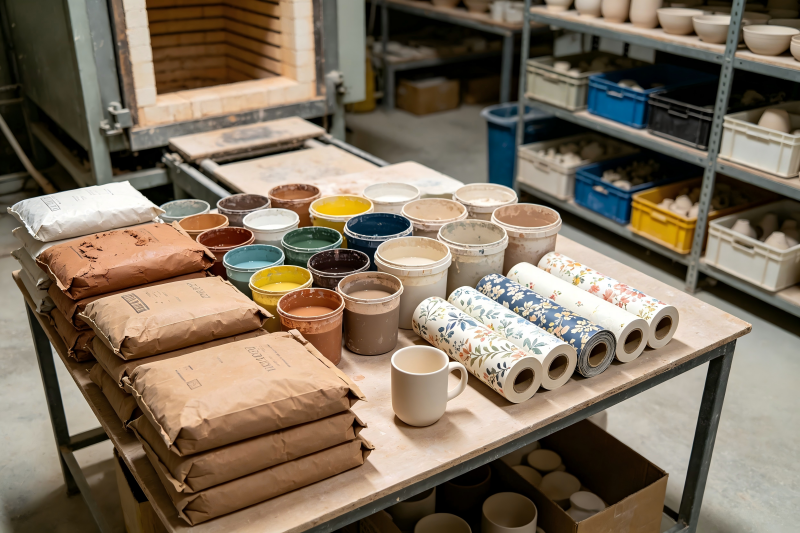
I once worked with a new buyer from the United States. He was very excited about a low price he received from a factory. But he overlooked the details in the quote. He later discovered that the high mold fee and a massive MOQ meant his total initial investment was double what he had budgeted for. This is a common story. The cheapest mug is rarely part of the cheapest project. To avoid this, you need to calculate your "total landed cost," which includes more than just the factory's price.
Understanding Your Total Landed Cost
Think of it as the final price you pay to get the mugs to your warehouse door. Many factors contribute to this cost. Experienced importers evaluate all of them before making a decision.
Here is a simple breakdown of what to look for beyond the price tag:
| Factor | What It Means for Your Business |
|---|---|
| MOQ (Minimum Order Quantity) | A low unit price is useless if you have to order 10,000 mugs when you only need 1,000. It ties up your cash in slow-moving inventory. |
| Tooling & Mold Costs | For custom-shaped mugs, a new mold is necessary. Some factories charge a high upfront fee, while others might waive it for very large orders. You must ask for this cost specifically. |
| Communication & Revisions | Time is money. If a factory takes days to respond to emails or has language barriers, it can cause delays and expensive mistakes in production. Smooth communication is priceless. |
| Logistics & Tariffs | The cost to ship a container from Asia is different from shipping one from Europe. Tariffs and port fees can also add a significant amount to your final cost. |
Always ask for a detailed quote that breaks down each of these costs. A transparent supplier will be happy to provide it. A supplier who only gives you a single unit price might be hiding something.
How Do You Match a Manufacturer to Your Business Model?
You run a boutique shop, but the factory only talks in container loads. Or you are a big retailer needing 50,000 units, but the supplier specializes in small, custom batches. A mismatch can kill your project.
Your business model dictates your ideal manufacturing partner. Large retailers need scale and consistency, often found in mature manufacturing hubs like China. Boutique brands may prioritize unique craftsmanship from places like Portugal. Startups need flexibility and low MOQs above all else.

In my experience, the most successful partnerships happen when the buyer's needs align with the factory's strengths. A factory like mine in Liling, China, is built for scale and customization. We have the infrastructure to produce large, consistent orders for global brands. But we might not be the best fit for someone who only needs 100 unique, handmade pieces. Understanding who you are as a business is the first step to finding the right partner. Let’s look at a few common business types and what they should look for.
For the Large Wholesaler or Retail Chain
If you supply major retailers, your priorities are volume, consistency, and social compliance. You need a factory that can produce tens of thousands of mugs that all look identical. You also need assurance that the factory meets ethical standards, like BSCI and ISO certifications. Mature ceramic industrial clusters, such as Liling in China or parts of Vietnam, are often a good choice. These areas have a deep supply chain, experienced labor, and a history of high-volume export. They understand the quality control and documentation required by large Western companies.
For the E-commerce Brand or Boutique Shop
Your brand is built on uniqueness and quality. You might not need 50,000 mugs, but you need your 2,000 mugs to be special. You should look for a factory that excels in customization. This means they are skilled with complex decals, unique glazes, and custom shapes. Communication is very important here. You need a partner who can understand your creative vision. While many Chinese factories are excellent at this, you might also explore manufacturers in places like Thailand or Portugal if you are seeking a very specific regional craft aesthetic. The key is finding a factory that is excited by design, not just by volume.
For the Startup or Promotional Products Company
For you, cash flow and speed are king. You need a low MOQ because you are testing a new idea or fulfilling a one-time order for a client. A higher unit price is acceptable if the minimum order is low. Look for factories or even specialized trading companies that welcome small orders. They often have stock mug shapes that can be quickly customized with a logo. This reduces the need for expensive mold fees and long development times. The ability to start small and test the market is more valuable than the lowest possible price per unit.
What Are the Right Questions to Ask a Potential Supplier?
You are sending emails to suppliers but getting generic answers. You feel like you are not getting the information you need to make a real decision. This leaves you feeling uncertain and at risk.
Stop asking "What is your price?". Instead, ask questions that reveal a supplier's process and capability. A good supplier welcomes detailed questions. This shifts the power to you and helps you vet partners for quality, reliability, and communication before you commit.

After over a decade of answering inquiries, I can tell the experienced buyers from the new ones by the questions they ask. New buyers focus only on price. Experienced buyers focus on process. They know that a good process is what guarantees quality, on-time delivery, and a successful partnership. Asking better questions is the single best way to reduce your sourcing risk. It shows the supplier you are a serious professional and forces them to prove their capabilities. This simple shift in approach will change the quality of the responses you get.
Here are some examples of how to reframe your questions:
| Instead of Asking This... | Ask This Instead... | Why It's a Better Question |
|---|---|---|
| "What is your best price?" | "Can you provide a tiered price for 1,000, 5,000, and 10,000 units? What are the separate costs for custom molds or multi-color decals?" | This shows their pricing structure and transparency. It also helps you understand how your costs will change as you scale. |
| "Can you make my design?" | "What is your process for developing a custom sample from a design file? What is the timeline and what's included?" | This tests their development process and communication skills. A good supplier will have a clear, step-by-step process. |
| "Do you have good quality?" | "What are your quality control checkpoints in production? Can you share a recent inspection report for a similar product you shipped to the US/EU?" | "Good quality" is subjective. This question forces them to explain their actual QC system and provide proof. |
| "When can you ship?" | "After I approve the final sample, what is your production lead time for 5,000 units? What are common shipping delays from your port?" | This gives you a more realistic timeline by breaking down the different stages. It also shows you are thinking about the entire logistics chain. |
A professional supplier will appreciate these questions. If a supplier is evasive or can't answer them clearly, that is a major red flag.
Conclusion
Finding the best country is about finding the right partner. Focus on your total cost, business needs, and ask smart questions to find a supplier that fits you perfectly.