Sourcing promotional products can feel like a race to the bottom, especially when clients are laser-focused on unit price. You find yourself caught between delivering the cheapest option and maintaining your quality standards. This pressure on sourcing custom coffee mugs for trade shows often squeezes your margins and risks damaging your reputation with a subpar product. The solution is to shift the conversation from cost to value, helping you source a higher-margin product that truly stands out.
Sourcing effective custom coffee mugs for trade shows involves looking beyond the unit price and focusing on total value. This means selecting a unique mug style and finish, choosing a customization process that enhances perceived value, and using smart packaging that solves logistical problems for the end client. This strategy creates a more profitable product for you and a more impactful giveaway for your customer.
This approach might seem counterintuitive when everyone is demanding lower costs. But in my 15 years of experience, I’ve seen that the most successful importers and wholesalers are the ones who master this pivot from price to value. Let's dive into how you can apply this thinking to your own sourcing strategy.
Why is focusing only on unit price a mistake for trade show mugs?
The pressure from your clients is real: they have a budget and want the most mugs for their money. This naturally leads you to hunt for the lowest possible unit price from suppliers. However, this narrow focus is a trap I see many first-time importers fall into.
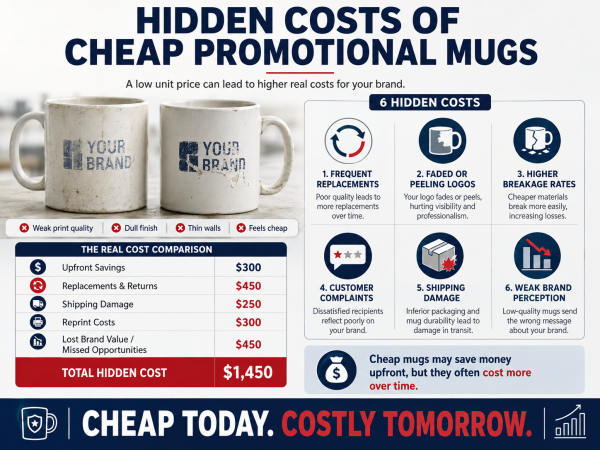
Focusing only on the rock-bottom unit price is a critical mistake because it ignores the total cost of ownership and, more importantly, the missed opportunity. A "cheaper" mug often comes with hidden costs from shipping damage, production delays, and a final product so unremarkable that it fails to make an impression.
Dive Deeper: The True Cost of a "Cheap" Mug
When you source based on price alone, you’re not just buying a mug; you’re buying a bundle of risks. I've seen these risks materialize into real costs for my clients time and again.
H3: The Hidden Financial Drain of Low Quality
The sticker price is just the beginning. The total cost of a poorly made mug includes:
- Damage and Breakage: Lower-quality ceramics are more brittle. Cheaper factories often cut corners on packaging to lower their quote. If 5-10% of your shipment arrives broken, the effective unit cost for the usable mugs skyrockets. I had a client who sourced from a new, unvetted factory to save $0.10 per mug on a 5,000-unit order. Nearly 15% of the shipment was damaged due to flimsy bulk packing, completely wiping out their entire profit margin.
- Reworks and Delays: A low price can be a sign of poor quality control. If a logo is printed crooked or the colors are wrong, the entire order might need to be reworked or discarded. This leads to costly delays, potentially causing your client to miss their trade show deadline—a disaster for everyone involved.
- Reputation Damage: Handing out a cheap, flimsy mug reflects poorly on your client's brand. And when your client is unhappy, it reflects poorly on you. Winning a customer's trust is hard; losing it over a low-quality promotional item is an unforced error.
H3: The Opportunity Cost of Low Perceived Value
This is the most important concept that successful wholesalers understand: perceived value arbitrage. It’s the gap between a product's actual cost and what a customer feels it's worth. This is where your profit margin lives.
Consider this real-world scenario I often discuss with my clients:
| Feature | Mug A (The "Cheap" Option) | Mug B (The "Value" Option) |
|---|---|---|
| Style | Standard 11oz C-handle | Modern 12oz V-shape |
| Finish | Basic glossy white | Smooth matte black exterior, glossy red interior |
| Your Sourcing Cost | $1.00 | $1.25 |
| End Client's Perception | "A basic, free giveaway." | "A premium, thoughtful gift." |
| Your Potential Sale Price | $1.50 (50% margin) | $2.50 (100% margin) |
| Your Profit Per Mug | $0.50 | $1.25 |
For just a $0.25 increase in your cost, you've created a product that looks twice as expensive. You can justify a much higher selling price, more than doubling your profit per unit. This is the power of focusing on value. You escape the race to the bottom and start competing on quality and design, which is a much more profitable game to play.
How do you choose the right customization for custom coffee mugs for trade shows?
Your client sends you a logo and a Pantone color, but your job isn't just to "put the logo on the mug." The customization method you choose is one of the most critical decisions affecting the final product's look, feel, and durability.
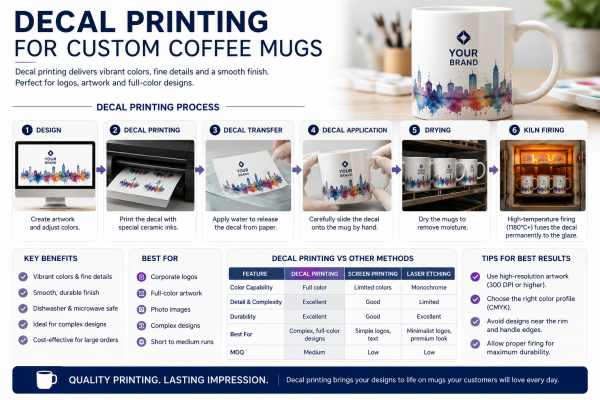
The right customization for custom coffee mugs for trade shows balances visual complexity, durability requirements, and budget to maximize the mug's perceived value. Choosing decal printing for a complex, full-color design, for example, creates a far more premium impression than attempting it with a less suitable method.
Dive Deeper: Matching the Method to the Mission
Each decoration technique offers a different trade-off between cost, appearance, and durability. Here’s how I advise my wholesale clients to think about the most common options for ceramic mugs.
H3: A Comparative Breakdown of Customization Processes
Understanding these methods allows you to guide your client toward the best choice for their specific goals, not just the cheapest one.
| Method | Best For | Durability | Typical Cost | Perceived Value |
|---|---|---|---|---|
| Decal Printing | Complex, multi-color, or full-wrap designs. Photographic images. | Very high (when fired correctly). Dishwasher safe. | Medium-High | Very High |
| Sublimation | Full-color designs on specially coated mugs. Good for smaller quantities. | High. Dishwasher safe, but can fade with extreme sun/heat exposure. | Medium | High |
| Screen Printing | Simple, 1-3 color logos. Large, solid blocks of color. | High. Typically dishwasher safe. | Low-Medium | Medium |
| Laser Engraving | Creating a subtle, permanent, high-end look by etching the glaze. | Permanent. Will outlast the mug itself. | High | Very High |
H3: A Story from the Factory Floor
A few years ago, a large promotional products distributor in Germany approached us for a 10,000-mug order. Their end client, a software company, had a beautiful, intricate logo with subtle gradients. The distributor’s initial request was for screen printing to keep the unit cost as low as possible.
I knew this was a mistake. Screen printing can't reproduce gradients well; the result would look flat and cheapen their client's brand.
Instead of just sending a quote, I had our team produce two samples.
- Sample A: The logo applied with 3-color screen printing, as requested.
- Sample B: The logo applied with full-color decal printing.
I shipped both to the client. The difference was night and day. The screen-printed version looked like a generic promotional item. The decal version looked like a piece of retail-quality merchandise. It had depth and vibrancy.
Though the decal mug cost about 18% more to produce, my client was able to sell it to the software company for 40% more than their original quote. They secured a larger-than-expected order and solidified their reputation as an expert consultant, not just an order-taker. This is the direct business impact of choosing the right customization process for custom coffee mugs for trade shows.
What mug styles and finishes add the most perceived value?
A standard white C-handle mug is the default for a reason: it's inexpensive and functional. But it’s also forgettable. At a noisy trade show where attendees are overloaded with stimulation, "forgettable" is the enemy.
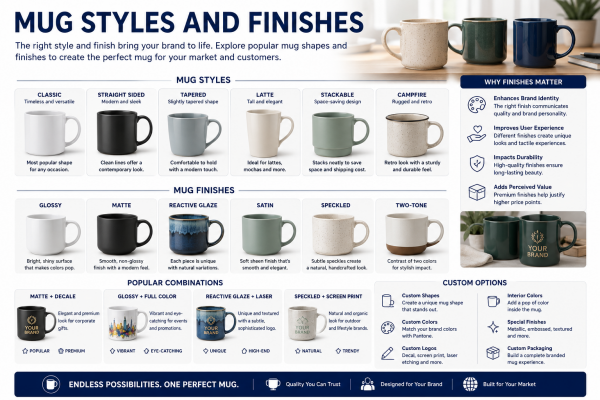
Unique shapes, satisfying weight, and premium finishes are what elevate a simple promotional item into a desirable gift. A potential customer is far more likely to carry, keep, and use a mug that feels substantial and looks thoughtfully designed, which directly translates to a higher perceived value.
Dive Deeper: The Tangible Details that Justify a Premium
During sourcing, small details make a huge difference in your ability to command a higher price. Here's what I recommend focusing on:
H3: Moving Beyond the Standard Shape
The silhouette of the mug is the first thing people notice. While the classic C-handle mug is a safe bet, exploring other shapes can immediately set your product apart.
- Barrel Mugs: These have a rounded, cozy shape that feels great to hold with two hands. They evoke a sense of warmth and comfort, making them perfect for brands related to home, hospitality, or wellness.
- V-Shape or Tapered Mugs: These mugs, which are wider at the top and narrower at the bottom, have a sleek, modern, and elegant profile. They feel more sophisticated and are an excellent match for tech companies, financial institutions, or luxury brands.
- Tankard Mugs: With a wider, stable base and a strong handle, these have a classic, durable feel. They suggest stability and tradition.
In my experience, simply switching from a standard shape to a V-shape can allow a wholesaler to increase their price by 15-20% because the item immediately looks more "designed."
H3: The Power of Glaze and Finish
The way a mug feels in your hand is just as important as how it looks. The glaze is your primary tool for controlling this tactile experience.
- Matte vs. Glossy: A glossy finish is traditional and makes colors pop. A matte finish, however, feels modern and premium. It doesn't show fingerprints as easily and provides a soft, velvety texture that people love.
- Two-Tone Glazes: This is one of my favorite recommendations for increasing value with minimal cost. A mug with a matte black exterior and a vibrant, glossy color on the interior is visually striking. It's a "surprise and delight" detail that makes the mug feel custom and intentional.
- Speckled Finishes: A speckled or "rustic" glaze gives the mug an artisanal, handcrafted feel. This style is incredibly popular right now, as it taps into the trend of authenticity and craftsmanship. It makes a mass-produced item feel unique.
When you present these options to your client, you're not just selling a mug. You're helping them choose a physical object that communicates their brand's specific personality—modern, cozy, rustic, or sophisticated. That's a value-added service they will pay for.
How does packaging impact the value of custom coffee mugs for trade shows?
You've sourced the perfect mug with a premium finish and flawless customization. Then, the factory ships it bulk-packed in large cartons with thin cardboard dividers. This is a common cost-cutting measure, but it's a huge mistake.
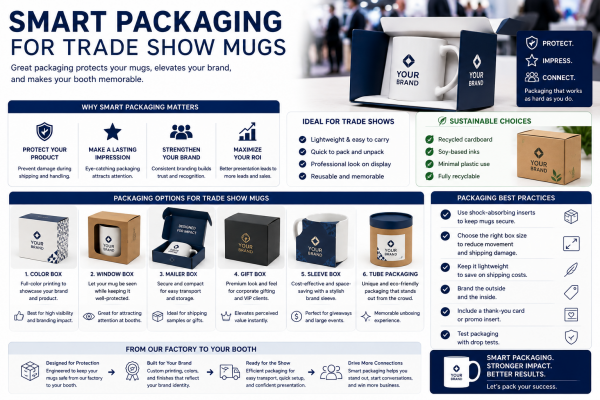
Smart packaging is not an expense; it's an investment that protects the product, enhances its presentation, and solves a major logistical problem for your client. For custom coffee mugs for trade shows, a well-packaged mug is part of the product itself and a key differentiator for you as a wholesaler.
Dive Deeper: Packaging as a Profit Center
Don't let packaging be an afterthought. Discussing it upfront in the sourcing process demonstrates your expertise and allows you to build more value into your offer.
H3: From Basic Protection to Enhanced Presentation
The primary job of packaging is to ensure the mug arrives safely. But it can do so much more.
- Bulk Packing: This is the cheapest option, where mugs are placed in large cartons separated only by thin dividers. I strongly advise against this for anything but the absolute lowest-budget local projects. The risk of breakage during international shipping is simply too high.
- Individual White Box: This is the professional standard. Each mug is placed in its own simple, sturdy cardboard box. This provides excellent protection against chipping and scratching. It instantly makes the product feel more like a retail item and less like a cheap giveaway. The cost is marginal, usually just a few cents per unit.
- Custom-Printed Gift Box: For a truly premium offering, a full-color printed box with a window or custom graphics turns the entire package into a marketing asset. It continues the branding experience from the mug to its container. While this adds more cost, it can elevate a $3 mug into a $10 perceived-value gift.
H3: Solving the Trade Show Logistics Headache
Here is a question I encourage all my wholesale clients to ask their customers: "How do you plan to store, handle, and distribute 2,000 mugs from your 10x10 foot booth?"
This question immediately reframes the conversation. Suddenly, the end client isn't thinking about the $0.05 they could save with bulk packing. They're picturing the logistical nightmare of unpacking massive cartons, dealing with broken pieces, and trying to hand out dusty, unboxed mugs to potential customers.
Individually boxed mugs solve this problem.
- They are easy to stack and store under a table.
- They are fast and clean to distribute.
- They provide a better recipient experience. Getting a boxed item feels more like receiving a real gift.
By offering individually boxed mugs as your standard, you are selling a complete, practical solution, not just a ceramic cylinder. This makes your offer far more compelling than a competitor's cheaper, bulk-packed alternative.
Frequently Asked Questions
What's the typical minimum order quantity (MOQ) for custom mugs?
For factory-direct orders, the MOQ typically starts at 500 to 1,000 units per design. This is because there are significant setup costs for molding, decal production, and kiln firing. Running smaller batches is inefficient and drives the per-unit cost up dramatically. Planning for these volumes is key for wholesalers.
How long does production and shipping take from China?
As a rule of thumb, you should plan for a 3 to 4-month lead time. Production itself, from sample approval to final packing, usually takes 30–45 days. Ocean freight to Europe or the Americas adds another 30–40 days, plus time for customs clearance. Always build a buffer into your timeline.
Are all custom ceramic mugs dishwasher and microwave safe?
Most high-fired stoneware mugs are inherently dishwasher and microwave safe. However, the customization can affect this. Mugs with metallic inks in the decal, for example, should never be put in a microwave. Always confirm these specifications with your supplier for each specific order and request documentation if needed.
What's the difference between ceramic, porcelain, and stoneware?
These terms describe different types of clay and firing processes. Stoneware is fired at a high temperature, making it very durable and non-porous, which is an excellent, cost-effective choice for promotional mugs. Porcelain is fired even hotter, making it lighter and more translucent, often perceived as more elegant and expensive.
Conclusion
The secret to profitably sourcing custom coffee mugs for trade shows isn’t about winning the race to the bottom on price. It's about becoming an expert consultant who guides clients toward creating maximum perceived value. By focusing on the total package—the mug's style and finish, the right customization method, and smart, practical packaging—you can build a product that commands a higher price and a better margin. This strategy shifts you from being a simple order-taker to a valuable sourcing partner. It protects your profitability and helps your clients make a lasting impression, ensuring they return to you for their next project.
As a ceramic factory with 15 years of experience exporting to wholesalers and importers across the Americas and Europe, we specialize in this value-driven approach. If you’re ready to build a more profitable promotional mug catalog, contact us today to discuss your sourcing needs.