Sourcing branded mugs for your next big campaign feels like it should be simple, but the hidden complexities can quickly turn an exciting project into a logistical nightmare. You worry about getting the design right, meeting your deadline, and what happens if the products arrive broken. The good news is that by focusing on the right factors, you can de-risk the entire process and ensure your campaign materials are a success.
The most critical factors when sourcing branded mugs for marketing campaigns are the total landed cost per usable mug, the logistical risks involved, and the supplier's ability to act as a manufacturing consultant. Focusing only on the low unit price often leads to catastrophic failures from high breakage rates, customs delays, and missed deadlines, making the initial savings irrelevant.
Now, I know "landed cost per usable mug" isn't a term most marketing managers use every day. But after 15 years of helping brands execute these projects, I can tell you it's the only number that truly matters. Let’s break down why this shift in perspective is the key to a successful campaign.
Why Is the Unit Price a Misleading Metric for Branded Mugs?
It’s completely natural to want to find the best deal, and a low per-unit price on a quote can feel like a big win. However, this initial sticker price often hides a minefield of downstream costs and risks that can inflate your budget and jeopardize your project. Relying on it is one of the most common mistakes I see.
The ex-factory unit price is just one piece of a much larger puzzle. It excludes essential costs like specialized packaging, ocean freight, insurance, import duties, and final delivery. A supplier offering a rock-bottom price might be cutting corners on these very things, leaving you to deal with the expensive consequences.
Dive Deeper: The Anatomy of "Landed Cost"
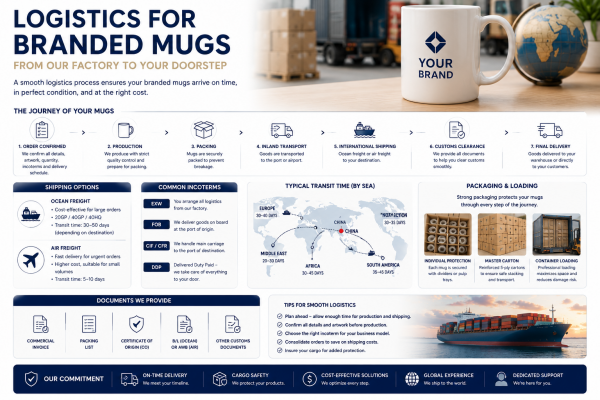
The "landed cost" is the total cost of a product once it has arrived at your final destination. For a marketing campaign, I take it a step further: the landed cost per usable mug. If 10% of your mugs arrive broken, your effective cost for the remaining 90% just went up by over 11%.
Over my 15 years running a ceramics factory, I've seen countless marketing teams get quotes that look deceptively simple. To protect your budget and your campaign, you need to see the full picture. Let's compare two hypothetical quotes for an order of 5,000 mugs.
| Cost Component | Supplier A (Consultative Partner) | Supplier B (Lowest Price) |
|---|---|---|
| Unit Price (Ex-Works) | $2.20 | $2.00 |
| Protective Packaging | $0.50 (Individual box + master carton) | $0.20 (Bulk packed, thin dividers) |
| Inland Freight to Port | $0.10 | $0.10 |
| Ocean Freight & Insurance | $0.40 | $0.40 |
| Tariffs & Customs Fees | $0.35 | $0.35 |
| Last-Mile Delivery | $0.25 | $0.25 |
| Total Landed Cost/Mug | $3.80 | $3.30 |
| Estimated Breakage | 1% (50 mugs) | 20% (1,000 mugs) |
| Usable Mugs | 4,950 | 4,000 |
| Total Project Cost | $19,000 | $16,500 |
| Landed Cost Per Usable Mug | $3.84 | $4.13 |
As you can see, the campaign that "saved" $2,500 upfront actually resulted in a higher cost for each usable mug. More importantly, they are now 1,000 mugs short for their event. This is the trap of the unit price. A good supplier will be transparent about these costs and explain the trade-offs. They don't just sell you a product; they help you plan a successful delivery. They should be able to provide clear details on:
- Packaging Solutions: Explaining options from bulk packing to individual gift boxes and how each impacts protection and cost.
- Freight & Logistics: Clarifying shipping terms (like FOB vs. CIF) and what they mean for your budget and responsibilities.
- Tariffs and Duties: Providing the correct HS code for your product so you can get an accurate estimate of import taxes from your customs broker.
The goal isn't to become a logistics expert overnight. The goal is to partner with someone who is, and who can help you see the complete financial picture before you commit.
What Should You Expect from a Manufacturing Partner for Your Branded Mugs?
You have a brilliant creative concept for your campaign, but will it actually work on a ceramic mug? A true manufacturing partner's job is to be your production consultant, not just an order-taker who says "yes" to everything. Their role is to bridge the gap between your vision and the physical realities of production.
You should expect a partner to proactively analyze your design and ask critical questions. They should advise you on how material choices, decoration techniques, and even handle shapes will impact durability, lead times, and the final cost. This collaborative process prevents costly surprises and ensures the final product lives up to your brand's standards.
Dive Deeper: From Creative Concept to Production Reality
When you send a design file to a factory, the conversation shouldn't end with "Okay, we'll make it." The best outcomes I've seen have always started with a detailed discussion about translating the creative concept into a feasible, durable, and cost-effective product.
Here are the key areas where a manufacturing consultant provides value:
-
Material Choices: You might just see a "white mug," but a factory sees options. Is it stoneware? Porcelain? Bone china? Each has different implications.
- Stoneware: Heavier, more rustic feel, generally more budget-friendly. Great for a cozy, coffee-shop vibe.
- Porcelain: More refined, brighter white, stronger, and more resistant to chipping than stoneware. It offers a more premium feel. I often guide clients to choose based on their brand identity. A rugged outdoor brand might prefer the heft of stoneware, while a luxury hotel chain would likely choose porcelain.
-
Decoration Methods: How your logo is applied is crucial for durability and brand perception.
- Decal Firing: This is the workhorse for durable branded mugs. The design is printed on special paper, applied to the mug, and then fired in a kiln at high temperatures. This process fuses the design into the glaze, making it vibrant and dishwasher-safe. It's the standard we use for our export clients in Europe and the Americas.
- Sublimation Printing: A faster, lower-cost method where the design is heat-pressed onto a coated mug. It’s good for complex, full-color photos, but it can be less resistant to scratching and fading over time compared to kiln-fired decals. A good partner explains these trade-offs. I once had a client who wanted a photorealistic image for a high-end corporate gift. We steered them toward a high-resolution decal and a specific firing cycle to ensure the image was not only sharp but would also last for years, protecting their brand's image.
-
Design Feasibility: Some designs look great on a screen but are challenging on a curved surface. Your partner should provide feedback on things like:
- Wrap-around art: How will the seams align?
- Inner rim or handle printing: These are more complex and require special processes.
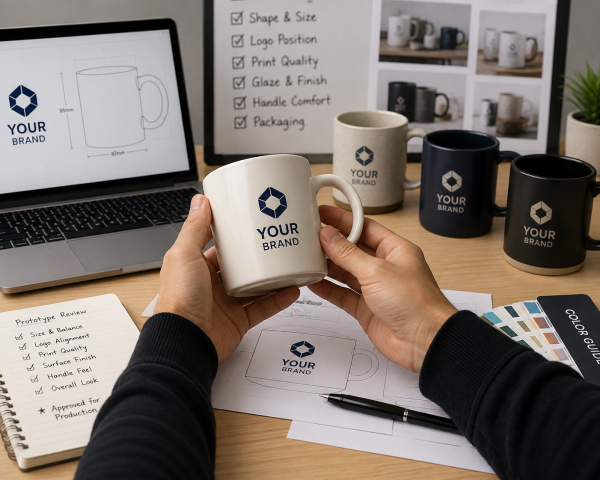
- Color matching: How will your specific Pantone brand color translate to a ceramic glaze? They should be able to produce a pre-production sample for your approval.
A supplier who just takes your file and sends an invoice is a risk. A partner who asks questions, provides samples, and explains the why behind their recommendations is an asset who will help you execute your campaign successfully.
How Can Poor Packaging Destroy Your Marketing Campaign?
You’ve spent weeks finalizing the design. You’ve approved the sample. The mugs are in production, and everything seems on track. But the single biggest point of failure I've witnessed in my career isn't the production itself—it's the packaging. The decision to save a few cents on a cardboard box can destroy thousands of dollars in value and derail your entire event.
Neglecting packaging is like building a beautiful car but forgetting the tires. The most common mistake is choosing thin, bulk-style packaging to reduce the unit cost. This "saving" is an illusion that evaporates the moment the first forklift touches the pallet, often leading to catastrophic breakage that renders a huge portion of your investment worthless.
Dive Deeper: The Cautionary Tale of the "Saved" $0.20
This isn't a theoretical risk. I want to share a story from a few years ago that I share with almost every new client. It’s an anonymous case, but the details are real and serve as a powerful lesson.
A marketing team from a fast-growing tech company in Europe was planning a major product launch. They decided on branded mugs as a key giveaway item for the press, partners, and their first 5,000 attendees. Their total order was for 10,000 mugs. The deadline was tight, and so was the budget.
They received two quotes. Our factory, Supplier A, quoted them a price that included individual "mailer" boxes for each mug—sturdy corrugated boxes designed to withstand shipping—which were then packed into a reinforced 5-ply master carton. Supplier B, a different factory, came in $0.20 cheaper per mug. Their quote specified basic packaging: thin cardboard dividers separating the mugs inside a standard master carton.
The marketing manager, under pressure to reduce costs, saw a quick win. A $0.20 saving on 10,000 mugs meant an immediate $2,000 reduction on the invoice. They chose Supplier B.
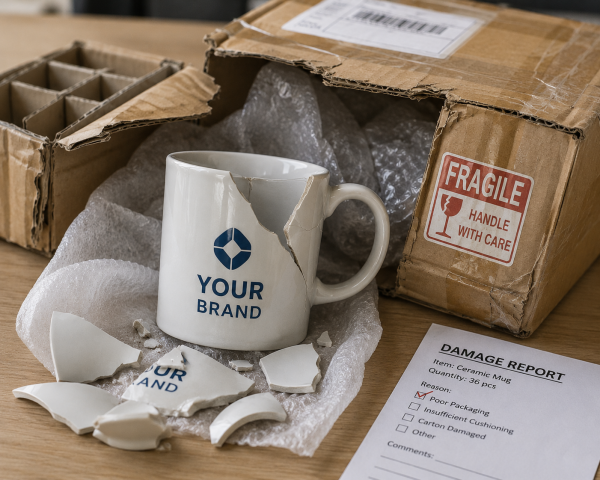
The shipment arrived at the event venue in Germany three days before the launch. When they opened the first few master cartons, their hearts sank. The thin dividers had collapsed under the weight and the normal stresses of ocean freight. Mugs had smashed against each other. As they unpacked more, the scale of the disaster became clear.
The final tally was a breakage rate of nearly 25%. Over 2,500 of their 10,000 mugs were completely unusable.
The marketing manager was now in a crisis.
- They didn't have enough mugs for the launch event.
- There was no time to produce and ship a replacement order.
- The $2,000 they "saved" was gone, replaced by a loss of $8,250 in product value (2,500 broken mugs x $3.30 landed cost), not to mention the intangible damage to their campaign.
The team had to scramble for a last-minute, locally-sourced replacement giveaway that didn't have the same brand impact. The beautiful mugs they had spent weeks designing ended up being a source of stress and failure, all to save $0.20 per unit. The landed cost per usable mug from that order wasn't the $3.30 they planned for; it was over $4.00, and they still didn't have enough.
This story illustrates the core thesis: risk management is more important than price negotiation. That $0.20 per mug wasn't a saving; it was a gamble they lost badly.
Frequently Asked Questions
How long does it take to produce custom branded mugs?
Production time typically ranges from 30 to 45 days, depending on the complexity of the design and the quantity. This does not include shipping time, which can add another 30-40 days for ocean freight to Europe or the Americas. Always plan for a total lead time of at least 90 days from order confirmation to final delivery.
What's the main difference between stoneware and porcelain for branded mugs?
The primary difference is refinement and durability. Porcelain is fired at a higher temperature, making it less porous, stronger, and more resistant to chipping than stoneware. It has a finer, brighter white appearance. Stoneware is thicker, heavier, and has a more rustic, earthy feel, and is often a more budget-conscious choice.
What does a BSCI or ISO9001 certification mean?
ISO 9001 is a certification for quality management systems, indicating the factory has documented processes to ensure consistent product quality. BSCI (Business Social Compliance Initiative) is an audit that assesses a factory's social compliance, including workplace conditions and labor rights. As a factory with both certifications, we find it assures our clients that we are a reliable and ethical partner. You should always ask for and verify these documents.
What is a reasonable breakage rate to expect for a shipment of mugs?
With proper packaging—meaning individual boxes and sturdy master cartons—the breakage rate during international transit should be well under 2%. For our shipments, we target less than 1%. If a supplier considers a 5-10% breakage rate to be "normal," it's a major red flag that they are cutting corners on packaging.
Conclusion
When sourcing branded mugs for your next marketing campaign, the path to success is paved with strategic thinking, not just cost-cutting. The sticker price is only the beginning of the story. The real metric of success is the "landed cost per usable mug," a figure that accounts for shipping, duties, and the crucial, often-overlooked factor of breakage. A low unit price is meaningless if a quarter of your products arrive in pieces, jeopardizing your event and wasting your budget.
Your supplier should be more than an order-taker; they should be a manufacturing consultant who helps you navigate material choices, design feasibility, and logistical risks. By prioritizing risk management and partnering with an expert who understands the entire supply chain, you can ensure your branded mugs arrive on time, on brand, and ready to make a positive impact.
If you are planning a marketing campaign and need a manufacturing partner who understands these risks, I invite you to reach out. We can help you plan your project to ensure it's a logistical success.