How Are Ceramic Coffee Mugs Mass Produced?
You need to order thousands of mugs, but choosing the right supplier feels like a gamble. A wrong choice means delays, bad quality, and lost profits.
The best way to vet a supplier is to understand their specific mass production methods. Mass production isn't a single process; it involves key choices in forming (like jiggering) and firing (like tunnel kilns) that directly affect a factory's ability to deliver consistent quality at scale[^1].
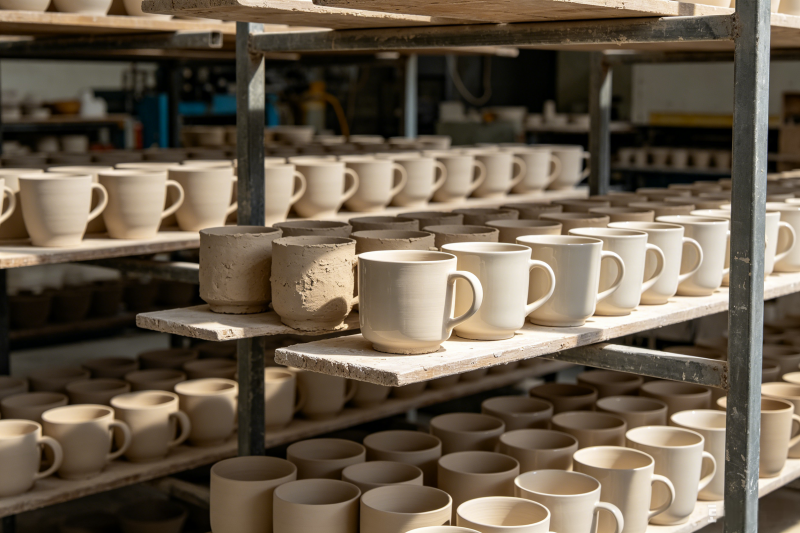
Over my 15 years in this business, many buyers start by asking, "How are your mugs made?" While it's a good starting point, it doesn't get to the heart of what a large-scale buyer needs to know. The real questions are about the choices we make during production.
These choices determine if a factory can handle your order of 100,000 units with the same quality from the first mug to the last. Let's break down the process from a buyer's point of view, so you can ask better questions and make a smarter choice.
What's the difference between slip casting and jiggering for my order?
You see different forming methods listed by suppliers, but it's unclear what they mean for your business. Choosing the wrong one can affect your design, timeline, and cost.
Jiggering is a highly automated method perfect for standard shapes like classic cylindrical mugs. It's fast, consistent, and cost-effective for large volumes[^2]. Slip casting is used for complex, custom shapes[^3]. It is more manual and generally slower, which can impact the cost and speed of very large orders.
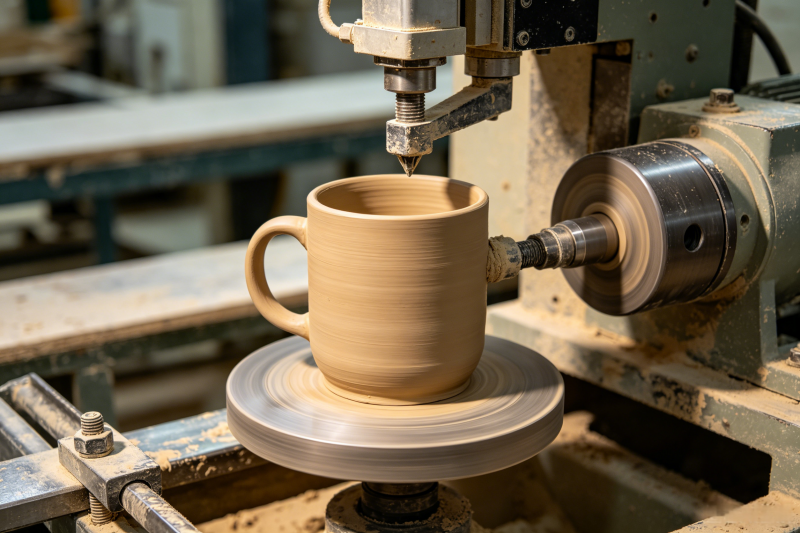
Choosing the right forming method is the first major decision point. It all depends on your mug's design and the quantity you need. As a manufacturer, we use both methods, but we guide our clients toward the one that makes the most sense for their business goals.
Jiggering (or Roller-Head Forming)
This is the workhorse of high-volume mug production. We start with a soft lump of clay and place it into a spinning mold. A heated roller-head then presses down and shapes the clay into a mug body in seconds. It’s incredibly fast and precise. The handles are typically made separately using slip casting and then attached by hand[^4].
Slip Casting
This method is for creativity and unique shapes. We create a plaster mold of the desired mug shape. Then, we pour liquid clay, called slip, into the mold. The plaster absorbs water from the slip, forming a clay wall. After a set time, we pour out the excess slip, and once the mug is firm enough, we open the mold. This is how you get mugs shaped like characters, animals, or other non-symmetrical designs.
Here is a simple breakdown for a procurement manager:
| Feature | Jiggering / Roller-Head | Slip Casting |
|---|---|---|
| Best For | High-volume, standard shapes (cylindrical, conical) | Complex, non-symmetrical shapes |
| Speed | Very fast, highly automated | Slower, more manual steps |
| Consistency | Excellent for orders of 100,000+ units | Good, but relies more on labor skill |
| Cost | Lower per unit for large runs | Higher per unit, especially for complex designs |
| Buyer's Question | "What is your daily capacity using jiggering?" | "What is the lead time for a new custom mold?" |
So, if you are a wholesaler needing 200,000 classic white mugs for cafes, you need a supplier with strong automated jiggering capabilities. If you are a promotional company wanting a mug shaped like your mascot, you need a factory with expert slip casting experience.
How do different kilns affect the consistency of a 100,000-mug order?
All factories fire their mugs, but the results can be very different. Inconsistent firing can create mugs with color variations or weaknesses, leading to customer complaints and damaging your brand's reputation.
For large orders, a factory using a continuous tunnel kiln is essential[^5]. Mugs travel through consistent temperature zones, ensuring every single piece is fired identically. Batch kilns, which fire mugs in static groups, can have slight variations between batches[^6], creating a risk for high-volume orders.
Firing is where a soft piece of clay becomes a hard, durable ceramic mug. This process is called vitrification[^7]. It melts the clay particles together, making the mug strong and non-porous so it won't absorb liquid. How a factory manages this process is critical for quality. The two main types of kilns used in mass production are tunnel kilns and batch kilns.
Tunnel Kilns
Imagine a very long tunnel, sometimes over 100 meters. Mugs are placed on carts that move slowly and continuously through the tunnel. The temperature is precisely controlled in different zones, from pre-heating to peak temperature and then cooling. This process ensures every single mug receives the exact same heat treatment. It's an industrial-scale solution built for consistency.
Batch Kilns (or Shuttle Kilns)
These are like giant ovens. Mugs are loaded onto carts, the carts are pushed into the kiln, and the door is closed. The entire chamber is heated up to temperature, held for a period, and then cooled down. While effective, there can be minor temperature differences inside the kiln or slight variations from one firing "batch" to the next.
For a large-scale buyer, the choice is clear:
| Feature | Tunnel Kiln | Batch Kiln (Shuttle Kiln) |
|---|---|---|
| Volume | High, continuous production | Lower, done in batches |
| Consistency | Extremely high across the entire order | High, but a small risk of variation between batches |
| Energy Use | More efficient for non-stop, large-scale production | Flexible for smaller, varied orders |
| Ideal Buyer | Supermarkets, wholesalers with 100k+ unit orders | Smaller brands, artisanal producers |
For our clients in Europe, North America, and South America, consistency is non-negotiable. A retailer cannot have mugs on the same shelf with slightly different shades of color. This is why our factory invested heavily in modern tunnel kilns. It's the only way we can guarantee that the 100,000th mug is identical to the first.
Why do quality systems like ISO9001 matter more than just the machines?
You see logos like ISO9001 and BSCI on supplier websites, and it's easy to dismiss them. But ignoring these certifications could mean you partner with a factory that has hidden quality issues or unethical practices.
Certifications like ISO9001 and BSCI are proof of a factory's reliability. They show a supplier has documented, repeatable processes to manage quality, consistency, and ethical standards from start to finish. They are your assurance that the factory can deliver on its promises.
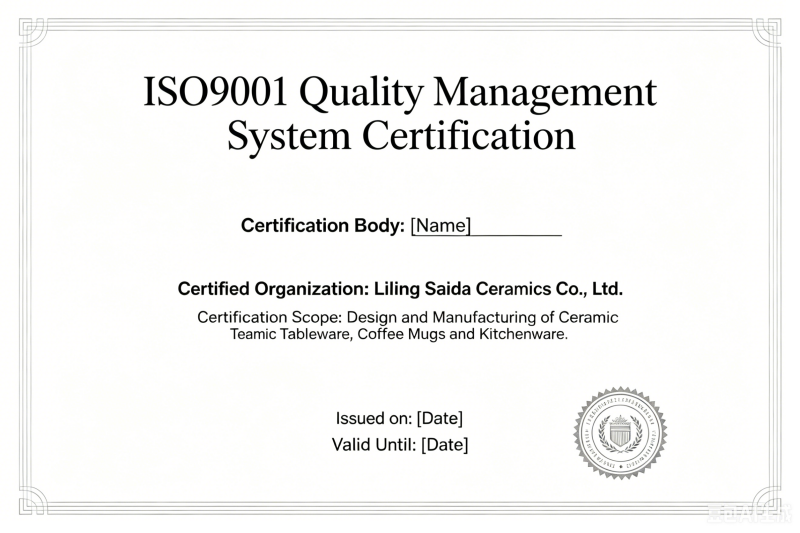
You can have the best machines in the world, but without strong management systems, you cannot guarantee a good result every time. This is something I've learned over 15 years of exporting mugs. For our large wholesale and retail clients, the systems behind the production are just as important as the production itself.
What do these certifications mean for you?
-
ISO 9001 (Quality Management System): This is not about the final product; it's about the process of making the product[^8]. An ISO 9001 certified factory has a rulebook for everything. We have documented procedures for inspecting raw clay, monitoring kiln temperatures, checking for defects after firing, and training our staff. This system forces us to be consistent. It means we catch problems before they affect your order. It's your guarantee that we are not just getting it right by accident, but by design.
-
BSCI (Business Social Compliance Initiative[^9]): This is about people and ethics. BSCI is an initiative to ensure that factories treat their workers fairly, provide safe working conditions, and follow local labor laws. For any major brand, this is non-negotiable. Partnering with a non-compliant factory poses a huge risk to your brand's reputation[^10]. Our BSCI certification shows our commitment to ethical manufacturing, protecting both our workers and our clients' brands.
Think of it this way: the machines are the car, but the management systems are the driver and the GPS. You need all three to reach your destination safely and on time. When you see that a supplier is certified, it tells you they are serious about their business and about protecting yours.
Conclusion
To source mass-produced mugs well, ask about methods, not just the final product. Understanding a supplier's forming, firing, and management systems is key to finding a true partner.
[^1]: "Ceramic forming techniques - Wikipedia", https://en.wikipedia.org/wiki/Ceramic_forming_techniques. Industrial ceramic manufacturing involves a series of process choices, where techniques for forming and firing are selected to meet specific targets for production volume, product consistency, and unit cost. Evidence role: general_support; source type: education. Supports: The claim that choices in forming (e.g., jiggering vs. casting) and firing (e.g., tunnel vs. batch kilns) are critical variables that determine the final quality, consistency, and cost-effectiveness of mass-produced ceramic goods..
[^2]: "Jiggering - Digitalfire", https://digitalfire.com/glossary/jiggering. Jiggering, also known as roller-head forming, is a mechanized technique for shaping clay inside a rotating mold, valued in industrial settings for its high speed, precision, and efficiency in producing symmetrical tableware like plates, bowls, and mugs. Evidence role: definition; source type: encyclopedia. Supports: The claim that jiggering is a highly automated process used in mass production for its speed and ability to consistently produce uniform, symmetrical ceramic shapes..
[^3]: "Slip casting - Wikipedia", https://en.wikipedia.org/wiki/Slip_casting. The slip casting process involves pouring liquid clay (slip) into a porous mold, which allows for the creation of intricate and non-radial shapes, making it a versatile method for custom or complex ceramic designs. Evidence role: mechanism; source type: paper. Supports: The claim that slip casting is employed for creating complex, non-symmetrical, or hollow ceramic forms that cannot be produced by other methods like jiggering..
[^4]: "How To Make Comfortable Mug Handles - Old Forge Creations", https://www.oldforgecreations.co.uk/blog/mug-handles. In industrial production of ceramic mugs, handles are commonly manufactured separately, often through slip casting, and then manually affixed to the machine-formed mug bodies by skilled workers before the final firing process. Evidence role: general_support; source type: other. Supports: The claim that in the mass production of jiggered mugs, the body is formed mechanically while the handle is typically cast separately and then attached to the mug body manually using slip as an adhesive before firing..
[^5]: "Kiln - Wikipedia", https://en.wikipedia.org/wiki/Kiln. Tunnel kilns are a cornerstone of modern, large-scale ceramic manufacturing, offering continuous processing and precise temperature control that leads to high product uniformity and energy efficiency, making them ideal for mass production. Evidence role: expert_consensus; source type: paper. Supports: The claim that tunnel kilns are the preferred technology for large-scale industrial ceramic production due to their high throughput and superior temperature consistency compared to batch kilns.. Scope note: The source may describe tunnel kilns as the industry standard or most efficient option for mass production, which supports the idea of them being 'essential' in a practical business context, though not literally indispensable in all scenarios.
[^6]: "Temperature uniformity evaluation of a shuttle kiln for the sanitary ...", https://ui.adsabs.harvard.edu/abs/2020CTM....24.1070R/abstract. While versatile, batch kilns can be subject to temperature non-uniformity within the firing chamber and potential process variations from one batch to the next, which can impact the consistency of properties like color and shrinkage in sensitive ceramic products. Evidence role: general_support; source type: paper. Supports: The claim that batch kilns (or shuttle kilns) may exhibit slight temperature variations within the chamber or between different firing cycles, which can lead to minor inconsistencies in color or size across a large production run..
[^7]: "Vitrification - Wikipedia", https://en.wikipedia.org/wiki/Vitrification. Vitrification is the progressive fusion and partial melting of clay and flux particles during firing, which fills open pores and results in a dense, strong, and impervious ceramic body with very low water absorption. Evidence role: definition; source type: encyclopedia. Supports: The definition of vitrification as the process where a clay body becomes dense, hard, and non-absorbent (glass-like) upon firing..
[^8]: "ISO 9001:2015 - Quality management systems — Requirements", https://www.iso.org/standard/62085.html. According to the International Organization for Standardization (ISO), the ISO 9001 standard provides a framework for a quality management system, emphasizing process control, continual improvement, and customer satisfaction, and is not a product certification. Evidence role: definition; source type: institution. Supports: The claim that the ISO 9001 standard specifies requirements for a quality management system (QMS), focusing on an organization's processes to consistently meet customer and regulatory requirements, rather than certifying the product itself..
[^9]: "amfori BSCI - Business Social Compliance Initiative", https://www.amfori.org/amfori-bsci/. The amfori Business Social Compliance Initiative (BSCI) is a supply chain management system that supports companies in driving social compliance and improvements within their global supply chains, based on a code of conduct covering topics like fair remuneration, decent working hours, and occupational health and safety. Evidence role: definition; source type: institution. Supports: The definition and purpose of the amfori Business Social Compliance Initiative (BSCI)..
[^10]: "Business Benefits and Impact of an Ethical Supply Chain", https://businessstories.sandiego.edu/business-benefits-and-impact-of-an-ethical-supply-chain. Research and case studies in supply chain management demonstrate that revelations of poor working conditions or unethical labor practices at supplier factories can lead to significant negative media attention, consumer boycotts, and lasting damage to a brand's reputation and market value. Evidence role: case_reference; source type: paper. Supports: The claim that major brands face significant reputational damage and consumer backlash when their products are found to be made in factories with poor labor standards or unethical practices..