Struggling to find the right custom ceramic mugs for corporate gifts? The endless options can be overwhelming, and you know that the wrong choice won't just be a waste of budget—it will reflect poorly on your brand. The pressure is on to find a gift that is both memorable and professional, but navigating the world of suppliers and materials feels like a minefield. This guide reframes the selection process, helping you move from a simple product search to a smart, risk-based decision.
The best custom ceramic mugs for corporate gifts are those that perfectly align with your gifting context, budget, and brand values. The ideal choice is less about a single "best" product and more about a strategic combination of material, printing method, and a thoroughly vetted supplier who can guarantee quality and protect your brand's reputation.
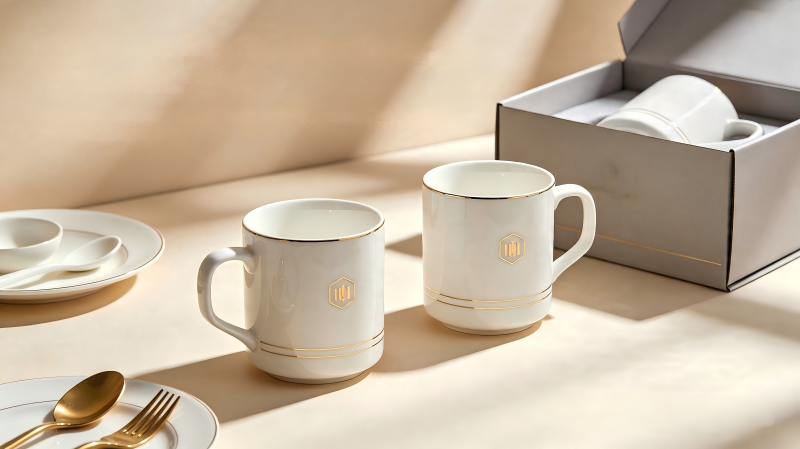
Choosing a mug is more than just picking a color and adding a logo. It’s a calculated decision with real consequences for your brand perception. Let’s dive deeper into a framework that, from our 15 years of manufacturing experience, has proven to help businesses make the right choice every time.
Why Is Your Gifting Context the First Question to Ask?
You're trying to get a simple price, but potential suppliers keep asking about your project's purpose. This can feel like an unnecessary delay. But what if those questions are actually the most important step in avoiding a costly mistake and ensuring your gift has the intended impact?
The gifting context—whether it's a mass giveaway for thousands or an exclusive gift for a dozen key clients—determines the required quality, customization complexity, and appropriate budget. This context is the single most important factor in defining the "right" mug for your needs.
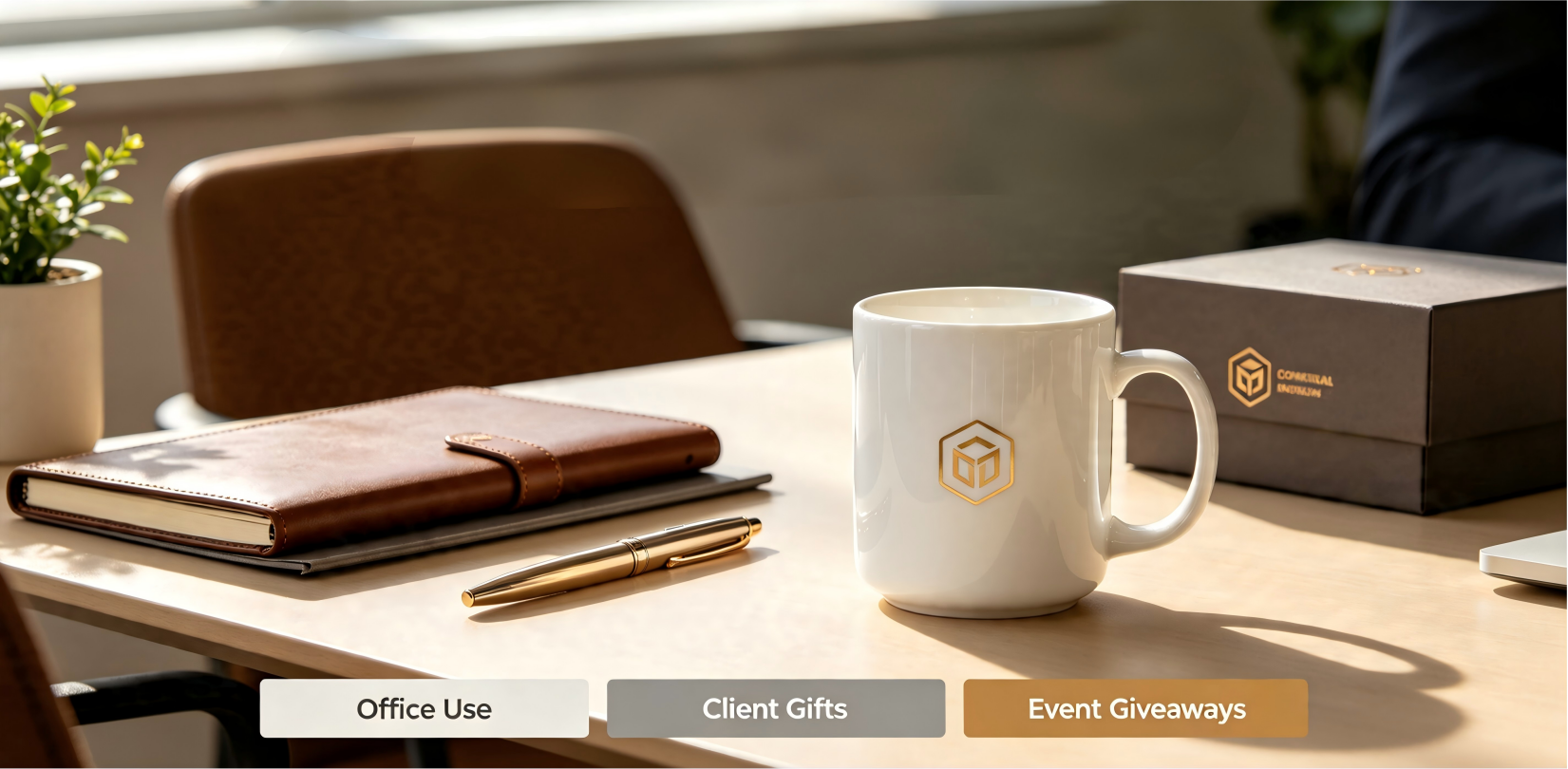
Over my 15 years in ceramic manufacturing, I've seen clients succeed when they match the mug to the moment. A mismatch is where problems begin. For example, ordering a premium, expensive mug for a trade show giveaway might exhaust your budget with little added benefit. Conversely, sending a cheap, low-quality mug to a high-value client can do more harm than good.
Let's break down three common corporate gifting scenarios.
H3: Mass Giveaways (e.g., Trade Shows, Conferences)
For large-scale events, the goal is brand visibility and broad reach. The mug needs to be a vehicle for your logo that thousands of people will see.
- Focus: Durability, cost-effectiveness, and clear branding.
- Archetype: A tech company planning a developer conference. They need 5,000 mugs that are sturdy enough to survive the event and daily use back at the office.
- Our Recommendation: Durable stoneware is an excellent choice. It's affordable, holds up well to daily use, and provides a great canvas for a prominent logo. A simple, one or two-color high-fire decal ensures the branding is permanent and won't wash off, protecting the investment.
H3: Employee Onboarding & Appreciation
Here, the mug is a tool for building company culture and making employees feel valued. It needs to be practical for daily office life and feel like a quality piece of equipment.
- Focus: Daily usability, quality feel, and a design that promotes a sense of belonging.
- Archetype: A fast-growing company welcoming new hires. They want a mug that becomes a fixture on each employee's desk.
- Our Recommendation: A classic-shaped porcelain or high-grade stoneware mug is ideal. It must be dishwasher and microwave safe. The design might be more subtle than a trade show mug—perhaps a logo on one side and a company value or motto on the other. This shows thoughtfulness beyond simple branding.
H3: High-Value Client & Executive Gifts
For this audience, the gift is a direct reflection of the value you place on the relationship. The mug must communicate prestige, quality, and exclusivity.
- Focus: Premium feel, perceived value, and sophisticated branding.
- Archetype: A law firm sending holiday gifts to its top clients. The goal is to express gratitude and reinforce a long-term partnership.
- Our Recommendation: New bone china or high-quality porcelain is the way to go. These materials are lighter, more translucent, and have a higher-end feel. Customization could include a subtle etched logo, a metallic rim (note: this makes it not microwave-safe), and, most importantly, premium packaging. A custom-printed gift box elevates the entire experience.
Here’s a table to summarize the decision-making process:
| Gifting Scenario | Primary Goal | Recommended Material | Customization Focus | Budget Tier |
|---|---|---|---|---|
| Mass Giveaway | Brand Visibility | Stoneware | Bold, durable logo | $ |
| Employee Gift | Culture & Utility | Porcelain, Stoneware | Dishwasher-safe, thoughtful design | $$ |
| Client/Executive Gift | Prestige & Gratitude | New Bone China, Porcelain | Elegant design, premium packaging | $$$ |
How Do Material and Printing Choices Impact Your Brand's Risk?
You've found a quote for custom mugs that seems too good to be true, and it fits perfectly within your tight budget. But what if that low price comes with a hidden cost—a logo that peels off after a few runs through the dishwasher, tarnishing the very brand image you paid to promote?
Material and printing methods are not just features; they are critical risk management decisions. Choosing a durable material like porcelain with a high-temperature decal print protects your brand's integrity for years. Conversely, opting for cheaper, low-quality alternatives can lead to defects that reflect poorly on your company.
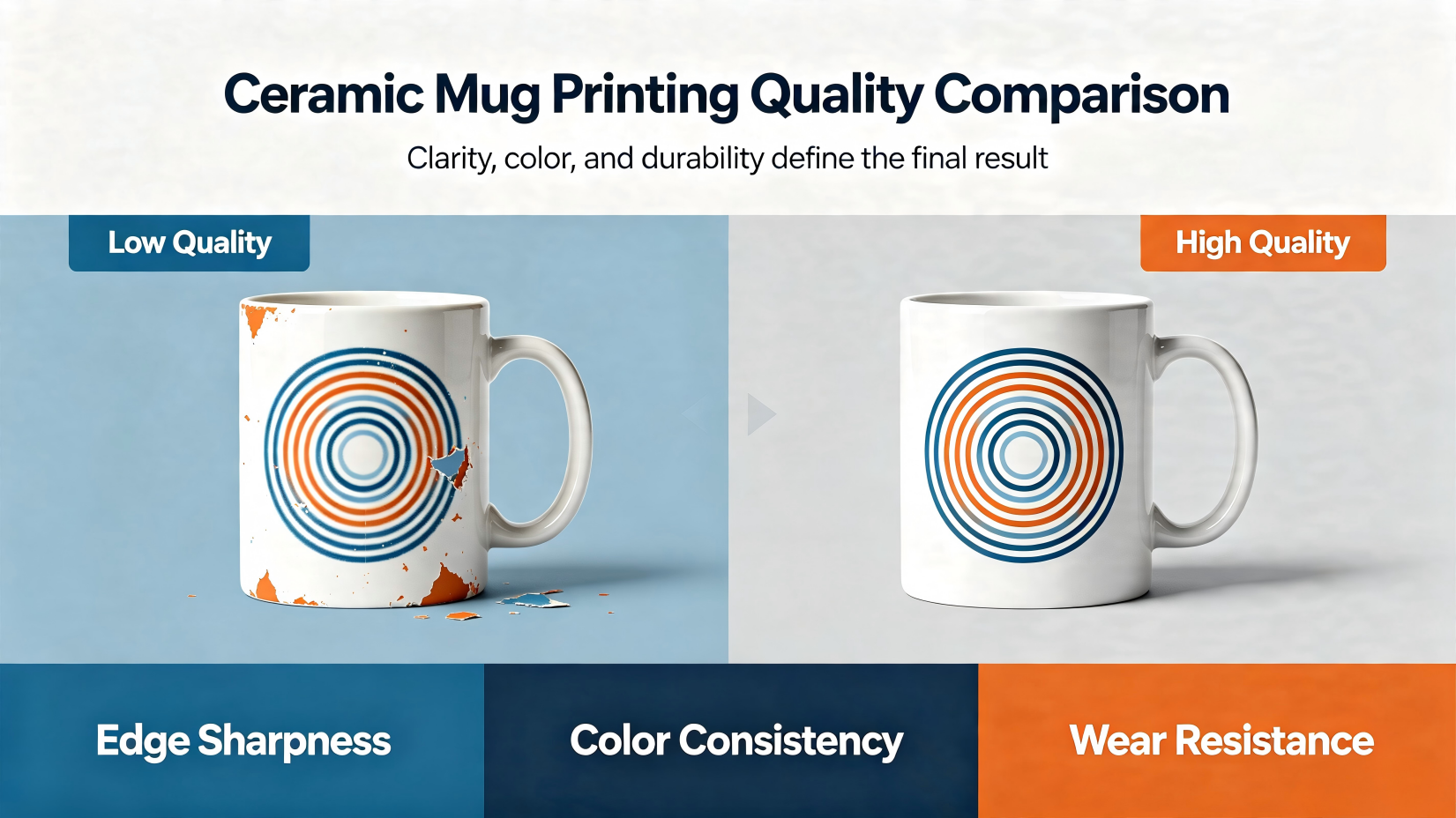
From our factory floor in Liling, we see the direct result of these choices every day. A well-made mug becomes a trusted daily companion. A poorly made one ends up in the trash, taking your brand's reputation with it.
H3: Choosing the Right Ceramic Body is a Strategic Choice
The type of ceramic you choose sets the stage for the entire product. It's not just about looks; it's about durability, perceived value, and suitability for the intended use.
-
Stoneware: This is the workhorse of the ceramic world. It's thick, sturdy, and opaque, with a rustic, earthy feel. Its durability makes it perfect for high-traffic environments like offices, restaurants, and large promotional giveaways.
-
Porcelain: More refined than stoneware, porcelain is fired at a higher temperature, making it non-porous and very durable despite often being thinner. Its smooth, white surface provides a pristine canvas for detailed logos and vibrant colors. It strikes a great balance between elegance and practicality.
-
New Bone China: This is a modern, high-end alternative to traditional bone china. It offers a similar lightweight feel, delicate translucency, and premium appearance without using animal bone ash, making it a more accessible and vegan-friendly option for luxury gifts.
-
Recommended Mug Styles
| Mug Type | Best For |
|---|---|
| 11oz C Handle | Trade Shows |
| 15oz Bistro | Employee Gifts |
| Reactive Mug | Executive Gifts |
| Camp Mug | Outdoor Brands |
| Stackable Mug | Hotels |
| Embossed Mug | Luxury Promotion |
H3: Understanding Printing Methods as an Investment in Your Brand
The way your logo is applied to the mug is just as important as the mug itself. This choice directly impacts the longevity and quality of your branding.
- High-Fire Decal Printing: This is the gold standard for permanence and quality, and it's our area of expertise. A decal with your design is printed and applied to the glazed mug. The mug is then fired again at a high temperature (over 800°C). This process fuses the decal into the glaze itself, making the design permanent, food-safe, and highly resistant to dishwashing and microwaving.
- Low-Fire Decal Printing: This method is cheaper because the mug is fired at a lower temperature after the decal is applied. While it can look good initially, the design essentially sits on top of the glaze rather than being fused into it. It is far more susceptible to scratching and peeling off after repeated washes. This is a major risk for a corporate gift.
- Sublimation: This process uses heat to transfer dye onto a specially coated mug. It's excellent for photorealistic images and complex, multi-color designs. However, the image can fade over time with prolonged exposure to UV light and harsh dishwasher cycles. It's best for novelty or limited-use gifts.
Here’s how these methods compare on key decision criteria:
| Printing Method | Durability | Color Complexity | Cost | Best For |
|---|---|---|---|---|
| High-Fire Decal | ★★★★★ (Permanent) | Excellent | $$$ | High-quality corporate gifts, daily use |
| Low-Fire Decal | ★☆☆☆☆ (Can peel) | Excellent | $ | Temporary or decorative items (Not recommended) |
| Sublimation | ★★★☆☆ (Can fade) | ★★★★★ (Photorealistic) | $$ | Full-color photos, complex gradients |
How Much Do Custom Ceramic Mugs for Corporate Gifts Actually Cost?
You need to establish a clear budget for your project, but every quote you receive is different, and no one seems to give you a simple price list. It's a frustrating process when you can't get a straight answer on what the final cost will be.
The cost for custom ceramic mugs for corporate gifts is not a single number; it's a dynamic range determined by six key factors: mug material, order volume, customization complexity, number of colors, packaging requirements, and shipping logistics. A trustworthy supplier will ask about these before providing a quote.
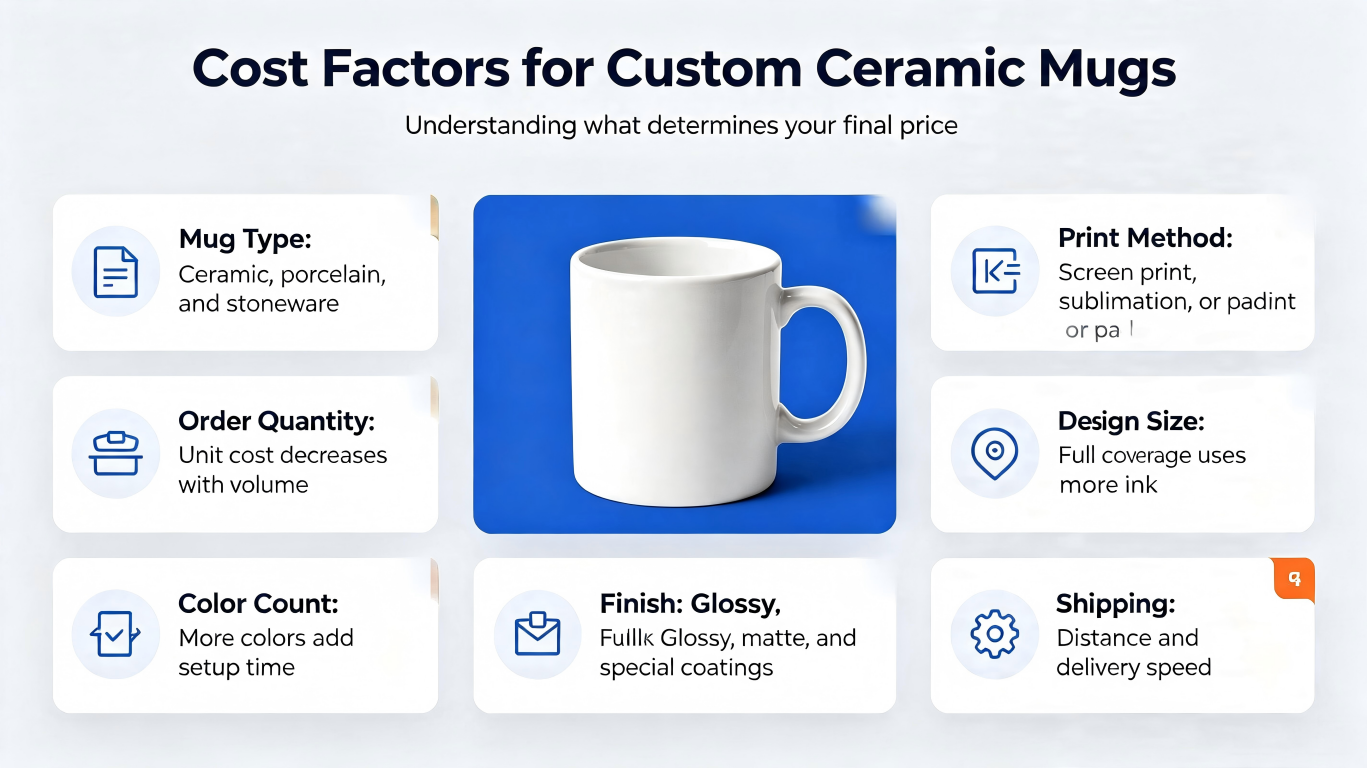
A common red flag we've seen is a supplier who provides a generic price list without asking any questions. An accurate quote is impossible without understanding the project's specifics. As a manufacturer, our goal is to provide an all-in, transparent price, which requires us to walk through these cost drivers with you.
H3: The Six Key Drivers of Custom Mug Cost
- Mug Material & Shape: The base cost starts here. A premium material like New Bone China will cost more than standard stoneware. Similarly, a unique or complex mug shape requires a special mold and more careful handling, increasing the price compared to a standard C-handle mug.
- Order Volume: This is one of the biggest factors. The higher your order quantity, the lower your price per unit. This is because the high fixed costs of setting up a production run (e.g., creating printing screens, calibrating machinery) are spread across more units. For factory-direct orders, Minimum Order Quantities (MOQs) are typically between 1,000 and 3,000 pieces to make production efficient.
- Customization Method & Complexity: The decoration itself heavily influences the cost. A large, full-wrap design that covers the entire mug is more expensive than a simple logo on one side due to the larger decal size and more complex application.
- Number of Colors: In decal printing, each color in your design often requires a separate screen to be created and applied. Therefore, a five-color logo will be more expensive to produce than a one-color logo.
- Packaging: How do you want your mugs delivered? The default is usually a bulk-packed master carton with simple dividers. If you require each mug to be in its own printed gift box, this will add a significant cost for both the box itself and the labor to pack it.
- Shipping & Incoterms: Your final landed cost depends on the shipping terms. A quote for FOB (Free On Board) means the price covers getting the goods to the port of origin; you are responsible for ocean freight, insurance, customs, and final delivery. A quote for DDP (Delivered Duty Paid) is an all-in price that includes shipping and import duties directly to your warehouse. Be sure you know which one you're getting.
Why Is Vetting Your Supplier More Important Than Vetting the Mug?
You've finally settled on the perfect mug design and material. But what happens if the supplier misses your critical event deadline, sends a shipment with a 20% defect rate, or can't provide the documentation needed to clear customs? The perfect product means nothing without a reliable partner to produce and deliver it.
Your supplier is both your biggest risk and your greatest asset. A thoroughly vetted manufacturer with proven certifications (like ISO9001 and BSCI), transparent quality control processes, and direct experience in your market is the best insurance you can have against project failure.
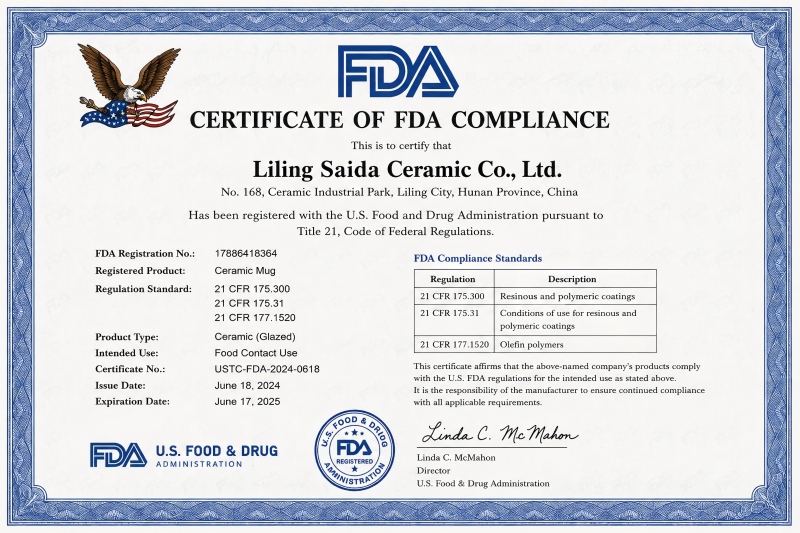
Focusing only on the mug's price is a common mistake. In my experience, the most successful projects come from clients who invest time in qualifying their manufacturing partner. A good partner doesn't just take an order; they guide you, anticipate problems, and take accountability for the final product.
H3: What to Ask For: Going Beyond the Brochure and Price List
When you evaluate a potential supplier, you need to dig deeper than their website. Ask for specific evidence of their capabilities and processes.
- Social & Quality System Certifications: Any factory can put a logo on their website. Ask for the full, unedited audit reports for certifications like BSCI (Business Social Compliance Initiative) and ISO9001 (Quality Management Systems). As a factory that maintains both, we know these audits are rigorous. Check the date on the report to ensure it's current. This proves their commitment to ethical labor practices and consistent quality.
- Production Capacity & MOQs: Be upfront about your volume. Ask about their production capacity to ensure they can handle your order without subcontracting it to an unvetted factory. Discuss their MOQ; if it's much lower than the 1,000-unit industry standard for manufacturers, they might be a trading company, not a factory.
- Quality Control & Defect Process: This is non-negotiable. Ask them two critical questions:
- "What is your AQL (Acceptable Quality Limit) for inspections?" This is a statistical standard for how many defects are considered acceptable in a batch.
- "What is your process for handling defects discovered upon delivery?" A trustworthy partner will have a clear policy for replacements or credits. If they avoid the question, it's a major red flag.
- Export Experience & Compliance: Shipping ceramics internationally involves complex regulations. A supplier must have experience with your specific market. Ask: "Have you shipped to the EU/USA/South America before?" They must understand requirements like FDA, California Prop 65, and EU food contact material regulations.
From our 15 years of exporting, we've learned that a smooth customs clearance process is just as important as a perfect print. An experienced partner anticipates documentation needs and ensures your shipment isn't delayed for compliance reasons.
Frequently Asked Questions
What is the minimum order quantity (MOQ) for custom mugs?
For factory-direct manufacturing, the MOQ typically ranges from 1,000 to 3,000 units. This quantity is necessary to make the production run cost-effective by spreading the high setup costs (like creating molds and printing screens) across a larger number of items, resulting in a lower price per mug.
Are custom ceramic mugs dishwasher and microwave safe?
It depends entirely on the materials and printing method used. Mugs made from high-quality stoneware or porcelain with a high-fire decal are almost always dishwasher and microwave safe. However, mugs with metallic prints should never be microwaved. Always confirm these specifications with your supplier for your specific design.
How long does it take to produce and ship custom mugs?
You should plan for a total lead time of at least 3 to 4 months. Production typically takes 30–45 days after sample approval. Ocean freight to Europe or the Americas can take another 30–40 days, plus time for customs clearance. Rushing the process can lead to compromises in quality, so it's best to plan well in advance.
Can I get a sample before placing a bulk order?
Absolutely. You should always request a pre-production sample (PPS) before authorizing a full production run. This sample is made using the exact materials and methods of your bulk order. While there might be a fee for the sample, it is a crucial step to approve the color, quality, and placement of your design, preventing costly surprises later.
Conclusion
Choosing the right custom ceramic mugs for corporate gifts is much more than a simple transaction; it's a strategic decision that directly reflects on your brand's quality and thoughtfulness. By shifting your focus from "which mug is cheapest?" to "which solution best manages my brand's risk?", you empower yourself to make a smarter investment. Remember to start with your gifting context, select materials and printing methods that guarantee longevity, and, most importantly, partner with a supplier whose credentials and processes you can trust. This approach ensures your corporate gift will be a lasting, positive representation of your company.
If you are a wholesaler, brand manager, or e-commerce seller looking for a reliable, certified manufacturing partner for your next project, our team is here to guide you. We'll help you navigate these questions to build a product you can be proud of. Contact us today to discuss your project and receive a detailed, transparent quote.