How Do You Find the Best China OEM Bulk Ceramic Coffee Mugs Supplier?
Sourcing ceramic mugs from China feels overwhelming. This decision can lead to quality issues and delays. The secret is finding the right partner for your specific business needs, not just a cheap one.[^1]
The best way to find a China OEM bulk ceramic mug supplier is to first define your specific business needs, such as for retail or promotional use. Then, you should vet suppliers on their proven capabilities in materials, customization, and compliance certifications like BSCI and ISO9001, rather than focusing only on the price.
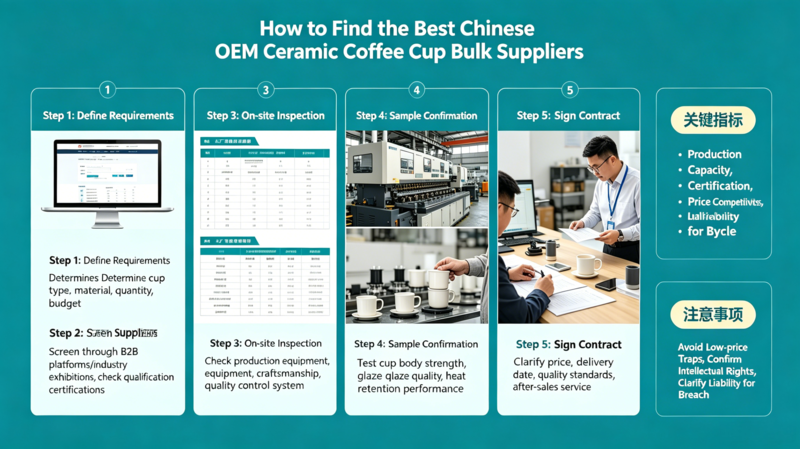
After 15 years of manufacturing ceramic mugs for export, I've spoken with hundreds of international buyers. The most successful ones, especially those buying for large supermarkets and wholesale businesses, don't start by asking about price.[^2] They start by asking a different set of questions. Their goal is to manage risk and build a reliable supply chain for the long term. This guide will walk you through their process. It will show you how to think like an experienced buyer and find a partner who can truly support your business growth. Let's explore the questions you should be asking.
What Does 'Good Quality' Really Mean for Your Business?
Every supplier you talk to will promise "good quality." But this term is vague. You're worried about receiving mugs that chip easily, have unsafe glazes, or feature logos that wash off after one use. You can avoid this by asking more specific questions.
"Good quality" is not a single feature but a combination of material durability, glaze safety, and decoration longevity. You must first define your specific quality standards, such as needing restaurant-grade durability or food-safe glazes for the EU market, and then find a supplier who can meet those requirements.
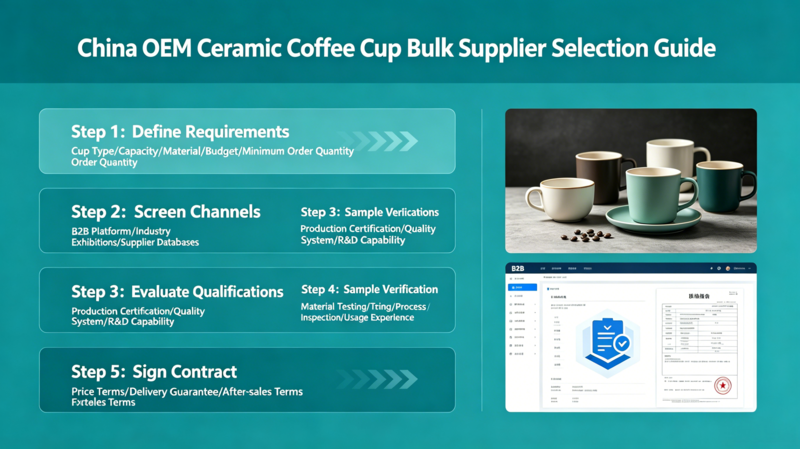
In my experience, "quality" is a business decision, not just a technical one. The "best" quality for a one-time promotional event is different from the "best" quality for a national restaurant chain. Your first step is to break down the concept of quality into factors that directly impact your business risk.
Matching Material to Use Case
The type of ceramic used is your first major decision. It affects durability, appearance, and cost. For our clients, this is a common starting point. A buyer for a hotel chain has very different needs than one for a retail gift shop. Here’s a simple breakdown we often use to guide our customers.
| Material | Best For | Why It Matters for Your Business |
|---|---|---|
| Stoneware | Restaurants, Hotels | High durability and chip-resistance means a lower replacement rate and better long-term value. |
| Porcelain | High-End Retail | Its strength, whiteness, and premium feel justify a higher price point for consumers. |
| New Bone China | Retail, Gift Shops | Offers a similar elegant look to bone china without the animal bone ash, at a more accessible cost. |
| Earthenware | Promotional Items | It's the most cost-effective option, ideal for large giveaways where budget is the main concern. |
Verifying Safety and Decoration Longevity
Once you choose a material, the next concerns are safety and how the branding holds up. Buyers for European and American markets are especially focused on this. A common question we get is, "How do I know the mugs are safe?" The answer is third-party testing. You should always ask for recent test reports for lead and cadmium, like EU food contact regulations or California's Prop 65.[^3] A professional supplier will have these readily available.
The decoration method is also critical. A logo that fades or peels is a direct reflection on your brand. For our wholesale and retail partners who need dishwasher-safe products, we always recommend in-glaze or on-glaze decal firing.[^4] This process fires the design onto the mug at high temperatures, making it permanent. Simpler methods like sublimation are fine for some uses, but they won't withstand the rigors of daily use and washing that a supermarket or restaurant product requires.
Are Certifications Like BSCI and ISO9001 Just Paperwork?
You see logos for BSCI and ISO9001 on supplier websites. It's easy to wonder if they are just marketing fluff. You need to know if they actually protect your business from real-world risks. Understanding these certifications is key to securing your supply chain.
These certifications are vital risk management tools. ISO9001 proves a supplier has consistent manufacturing processes, reducing batch-to-batch variations.[^5] BSCI demonstrates social compliance, which is essential for brand protection and accessing European retail markets.[^6] They are not just paperwork; they are proof of professionalism.
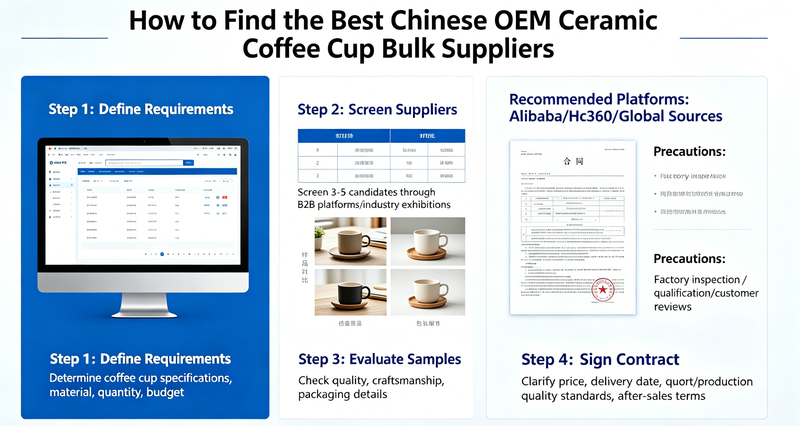
From our factory in Liling, Hunan, we know these certifications are not just for show. They are a core part of our business because they are a core part of our customers' businesses. For large supermarkets and wholesalers, sourcing from a certified factory is a non-negotiable requirement. It's about minimizing risk before the first order is even placed.
ISO9001: Your Shield Against Inconsistency
Many buyers mistakenly think ISO9001 is a guarantee of product quality. It's not. Instead, it's a guarantee of process quality. An ISO9001 certified factory like ours has documented, repeatable procedures for every step, from inspecting raw clay to packing the final order.
What does this mean for you as a buyer? It means predictability. When you order 50,000 mugs, you can be confident that the 50,000th mug will be the same color, shape, and size as the first. It reduces the risk of unexpected and costly variations that can happen with a supplier who lacks standardized controls. This consistency is the foundation of any large-scale retail or wholesale program.
BSCI: Protecting Your Brand's Reputation
The Business Social Compliance Initiative (BSCI) is about people. It's an audit that verifies a factory meets standards for fair wages, safe working conditions, and reasonable hours. For our customers targeting European markets, this is absolutely critical. Major European retailers will not work with supply chains that are not socially compliant.[^7]
Sourcing from a non-BSCI audited factory exposes your brand to significant risk. A single news story about poor labor conditions in your supply chain can destroy your brand's reputation[^8] and lead to being delisted by major retail partners. As a BSCI-compliant manufacturer, we provide our partners with the assurance they need to sell our products confidently. This certification is a direct investment in your brand's safety and market access.
Are You Asking the Right Questions to Your Supplier?
Your first instinct might be to ask for the price per mug. This is a common starting point for many new buyers. But this approach often attracts suppliers who cut corners to give you the lowest number. Asking value-focused questions instead signals that you are a serious, long-term partner.
Instead of asking "What's your price?", experienced buyers ask: "What is your MOQ for stoneware?", "Can you share a recent EU compliance report?", and "What is the lead time for a 50,000-piece order?". These questions reveal a supplier's true capabilities far more than a simple price quote.
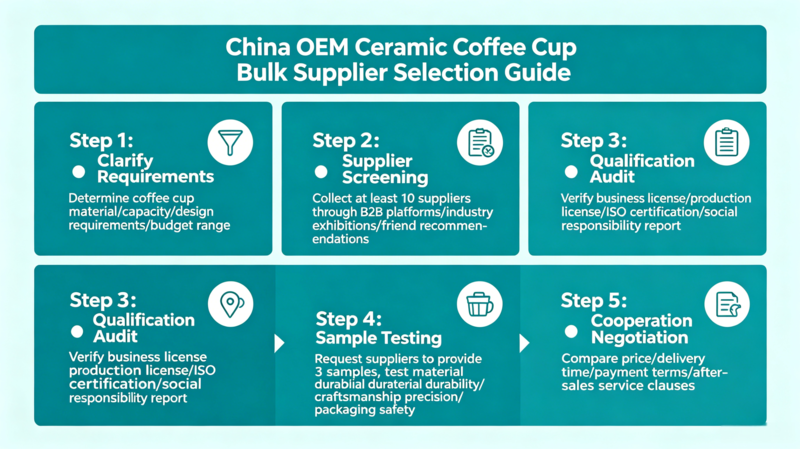
In my 15 years of exporting mugs, I can tell a lot about a potential partner by the first questions they ask. When a buyer leads with detailed questions about process, compliance, and capacity, we know they are a professional. We know they are looking for a reliable partnership, not just a cheap transaction. This immediately changes the dynamic of our conversation and allows us to provide more meaningful, specific information.
From Novice Questions to Expert Inquiries
Switching your questions is the fastest way to improve your sourcing outcomes. It forces the supplier to demonstrate their expertise and gives you a much clearer picture of their capabilities. Here is how you can reframe your approach.
| Novice Question | Why It's Weak | Expert Question | Why It's Strong |
|---|---|---|---|
| "What's your price?" | Invites low-quality bids. Price is meaningless without context (material, size, decoration). | "What is your price for a 12oz stoneware mug, MOQ 10,000 units, with a two-color fired decal?" | Provides specific parameters, allowing for an accurate quote and showing you've done your homework. |
| "Is your quality good?" | Subjective and unverifiable. Every supplier will say yes. | "Can you provide your latest EU food contact or Prop 65 test report?" | Asks for specific, verifiable proof of compliance and safety. A professional supplier will have this ready. |
| "Can you make this mug?" | Too open-ended and simple. It doesn't test their limits or process knowledge. | "What is your production lead time for a 40ft container order after the sample is approved?" | Tests their understanding of real-world logistics and capacity for large orders, which is crucial for wholesalers. |
Asking expert questions shows you understand the manufacturing process.[^9] It tells the supplier that you value transparency, compliance, and reliability over a simple low price. As a manufacturer, these are the types of clients we prioritize because they are the foundation of a stable, long-term business relationship.
Conclusion
Finding the right OEM mug supplier is not about the lowest price. It is about matching your specific needs with a partner who proves their quality, compliance, and capacity through transparent processes.
[^1]: "Assessing the Best Supplier Selection Criteria in Supply Chain ...", https://pmc.ncbi.nlm.nih.gov/articles/PMC9102987/. Research on supplier selection models consistently identifies quality, reliability, and capability alignment as more significant long-term factors than initial price in manufacturing partnerships. Evidence role: expert_consensus; source type: paper. Supports: that strategic partner selection criteria outweigh price considerations in manufacturing sourcing. Scope note: Specific weightings of criteria may vary by industry and order volume. [^2]: "Improving Procurement Strategy in Supply Chain Management", https://www.apu.apus.edu/area-of-study/business-and-management/resources/improving-procurement-strategy-in-supply-chain-management/. Studies of professional procurement practices show that strategic buyers for large retail organizations typically employ multi-criteria decision models where price is one of several factors, not the primary determinant. Evidence role: expert_consensus; source type: research. Supports: that experienced procurement professionals prioritize quality and reliability over price in strategic sourcing. Scope note: Behavioral patterns may differ across industries and company sizes. [^3]: "Exposure to lead and cadmium released from ceramics ... - PubMed", https://pubmed.ncbi.nlm.nih.gov/25526575/. EU Regulation 1935/2004 and California's Proposition 65 establish specific migration limits for lead and cadmium from ceramic food contact materials, requiring manufacturers to conduct regular testing and maintain compliance documentation. Evidence role: definition; source type: government. Supports: the specific regulatory limits and testing requirements for lead and cadmium in ceramic food contact materials. Scope note: Regulatory limits and testing methodologies may be updated periodically. [^4]: "21 CFR 109.16 -- Ornamental and decorative ceramicware. - eCFR", https://www.ecfr.gov/current/title-21/chapter-I/subchapter-B/part-109/subpart-A/section-109.16. Ceramic engineering research demonstrates that in-glaze and on-glaze decoration methods, where designs are fired at high temperatures (typically above 800°C), create chemically bonded, permanent surfaces that withstand repeated dishwasher cycles unlike surface-applied decorations. Evidence role: mechanism; source type: paper. Supports: the technical superiority of in-glaze and on-glaze firing methods for creating permanent, dishwasher-resistant decorations. Scope note: Actual durability depends on specific firing temperatures and glaze compositions. : "Quality Control Standards for Batch Effect Evaluation and Correction ...", https://pmc.ncbi.nlm.nih.gov/articles/PMC12120824/. The ISO9001 standard requires documented quality management systems including process controls, monitoring, and continuous improvement mechanisms that systematically reduce batch-to-batch variation in manufacturing. Evidence role: definition; source type: institution. Supports: how ISO9001 quality management systems standardize manufacturing processes to reduce variability. Scope note: Certification indicates system implementation but does not guarantee individual product quality. [^6]: "Legal - U.S. Department of Labor", https://www.dol.gov/agencies/ilab/sourcingstrong/why-develop-a-social-compliance-system/legal-compliance. The Business Social Compliance Initiative (BSCI) provides an audit framework that many European retailers require for supplier compliance, addressing labor standards that impact brand reputation and market access. Evidence role: general_support; source type: institution. Supports: the role of BSCI and similar social compliance standards in meeting European retailer requirements. Scope note: Specific retailer requirements may vary beyond BSCI alone. [^7]: "State of Social Procurement: The Role of Supply Chain Regulation", https://initiatives.weforum.org/global-alliance-for-social-entrepreneurship/socproc-supply-chain-regulation. Multiple studies of European retail procurement practices document the widespread adoption of social compliance standards as mandatory supplier requirements, driven by consumer pressure and regulatory expectations. Evidence role: expert_consensus; source type: research. Supports: that social compliance has become a standard requirement for major European retailers. Scope note: Implementation rigor and specific standards may vary by retailer. [^8]: "The Importance of Corporate Reputation for Sustainable Supply ...", https://pmc.ncbi.nlm.nih.gov/articles/PMC9559133/. Multiple case studies in business ethics literature document significant brand value destruction and consumer backlash following exposure of poor labor conditions in supply chains, particularly in consumer goods manufacturing. Evidence role: case_reference; source type: research. Supports: the demonstrated impact of supply chain labor issues on corporate reputation. Scope note: Impact magnitude varies by brand equity and consumer market sensitivity. [^9]: "The impact of buyer-supplier communication on performance", https://www.sciencedirect.com/science/article/abs/pii/S0925527322003437. Research on industrial buyer-supplier interactions indicates that question specificity and technical depth serve as credible signals of buyer expertise, influencing supplier response quality and partnership dynamics. Evidence role: expert_consensus; source type: paper. Supports: that technical questioning patterns signal buyer sophistication in manufacturing contexts. Scope note: Cultural and industry-specific communication norms may affect interpretations.